A taxi or shuttle fleet makes two separate decisions: how energy returns to the vehicle, by swapping a pack or connecting to a supply, and how many packs each vehicle needs to cover its shift. A conclusion about one does not answer the other. This article uses the Solar Taxi Electric Vehicle with Battery Swap as its reference model. Its product page states a swappable 9.8 kWh lithium iron phosphate pack, a swap of about fifty seconds, an NEDC-rated laboratory range of 200 km per pack, a real-world range of 100 to 160 km, and a roof photovoltaic contribution of about 30 km per day under adequate sunlight, among the figures listed in Section 6. Every figure is a manufacturer-stated specification from the product page, not a third-party measurement, independent verification, or industry-wide value.
This is an operating-method guide for fleet buyers. It gives the inputs and questions to resolve before an order, and it offers no universal pack count, swap station budget, or per-kilometer cost, since the product page states that packs per vehicle depend on fleet size and shift pattern and are calculated by the supplier against actual operations.
The short version
- Separate the replenishment decision from the pack inventory decision. A swap time says nothing, on its own, about how many packs a vehicle carries.
- Three site situations change the constraints: no stable charging point, a weak grid, and two-shift operation. Document each as a constraint, not as a verdict.
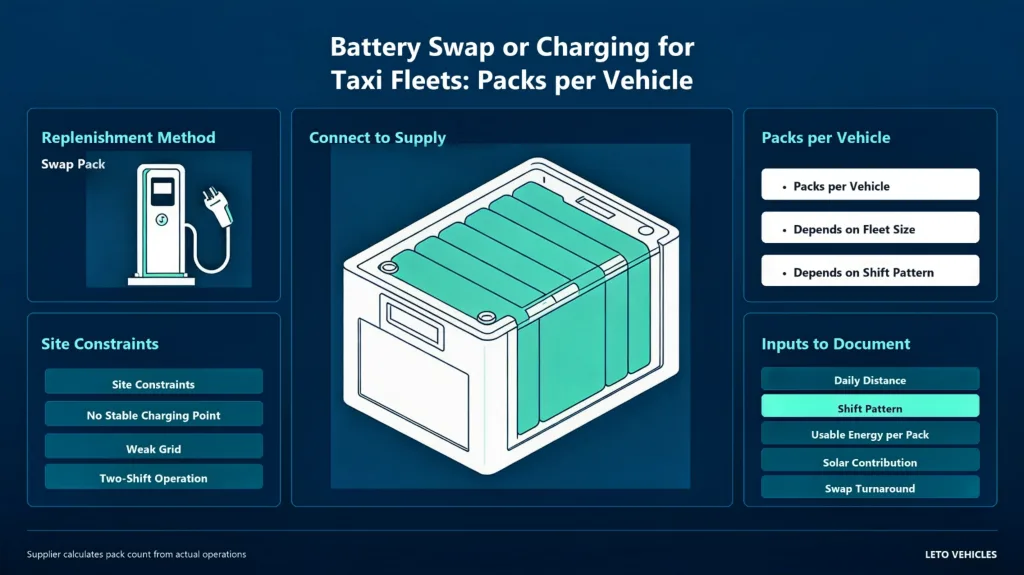
- Build pack inventory from daily distance, shift pattern, usable energy per pack, the stated daily solar contribution, and swap turnaround. The supplier calculates the count from the buyer’s actual operation.
- Read about 30 km per day as a manufacturer-stated energy contribution under adequate sunlight, as stated on the product page, not single-charge range, not a guarantee, not an annual average, and not a regional typical value.
- Keep V2L on the consumption side. Its 220 V output is a load on the pack, not added driving range.
- Collect written answers from the supplier before placing an order, including fleet size, daily distance, shift pattern, and the pack count calculated from them.
1. Treat replenishment choice and pack inventory as two decisions
Buyers often merge these two questions because both involve batteries. Keeping them apart makes the discussion cleaner.
Replenishment choice is about the method: swap a pack, or connect to a supply. It depends on the site, the equipment, and the time available between shifts. A battery swap vs charging comparison is a useful way to frame that question, since it sets out the two arrangements side by side.
Pack inventory is about quantity: how many packs sit with each vehicle or at the depot so that a vehicle can keep working. It depends on the duty cycle, not on the choice of method alone. A fleet that swaps still has to decide how many packs to hold, and a fleet that charges still has to decide how many vehicles can charge at once.
A stated swap time of about fifty seconds, as stated on the product page, describes how long the exchange takes. It does not state how many packs are required. Treating the two as the same figure is a common planning error.
2. Read the three site situations as constraints, not verdicts
Three site situations recur in taxi and shuttle planning. Each is a set of constraints to record before a supplier discussion.
No stable charging point. Where fixed chargers are absent or unreliable, record what supply exists at the depot, at the rank, and at intermediate stops, and how reliable each is. The question is what the site can support on a normal day, not which method wins in general.
A weak grid. Where supply is limited or subject to interruption, the power at the connection point becomes an input. Record the supply rating, known limits, and whether upgrades are possible. The daily solar contribution of about 30 km, as stated on the product page, is a separate item, not a reason to set aside the grid question. It is stated under adequate sunlight and is not a guarantee, a seasonal average, or a value for any location.
Two-shift operation. Where vehicles run across two shifts, the gap is short and demand changes. Record shift boundaries, downtime between shifts, and whether packs are exchanged at the depot or at the vehicle. A two-shift pattern changes the timing of every energy decision.
For each situation, write the constraint in measurable terms and hand it to the supplier. None of these situations produces a pack count on its own.
3. List the inputs that drive pack inventory
Pack inventory is derived, not looked up. Give the supplier the following inputs, and ask them to do the calculation against the real operation.
Daily distance. Log average daily distance over a representative period, including quiet and busy days, since an average hides the spread.
Shift pattern. Record the number of shifts, the hours of each, and the interval available for replenishment between them.
Usable energy per pack. For the Solar Taxi swap configuration, the product page states a 9.8 kWh lithium iron phosphate pack. Ask the supplier to confirm usable energy for the exact configuration, since nameplate and usable figures differ.
Daily solar contribution. The product page states about 30 km of range per day under adequate sunlight, as stated on the product page. This is a manufacturer-stated energy contribution, not single-charge range or a measured or guaranteed amount. A solar electric car daily range explainer covers how that figure is framed across models. Treat it as one input to discuss, not a fixed reduction in grid draw or in packs held.
Swap turnaround. The product page states a swap of about fifty seconds. Record the time available at the point of exchange, including queue and handling time, and ask the supplier how turnaround is defined.
Fleet size and duty profile. A sizing a delivery fleet exercise covers how fleet size is approached. The product page states that packs per vehicle depend on fleet size and shift pattern, with the supplier calculating the count from actual operations. This article supplies no number, example result, or rule of thumb, since none follows without a measured operating record.
4. Keep the swap configuration distinct from socket and 220 V charging
The Solar Taxi is described on its product page as a swap configuration without on-board charging. That differs from a vehicle refilling from a domestic socket or a 220 V supply, because it changes what is installed, where energy is stored, and who handles the packs.
This article takes the fleet operations view: it asks what the site and shift pattern require, then passes those requirements to the supplier, and it does not restate a charging configuration table. For the swap configuration, ask where exchanges happen, how packs are stored, and who handles them between shifts. For a charging configuration, ask about the supply at the parking location, the on-board charger, and stationary hours. Do not carry a swap conclusion to a charging vehicle, or the reverse.
Fleet replenishment also has an ongoing side: packs and connections need routine attention, and that work sits with operations rather than the purchase decision. A fleet charging and maintenance reference can frame those questions. Neither that reference nor this article promises battery life or a maintenance-free arrangement.
5. Put V2L on the consumption side
V2L, or vehicle-to-load, is an outlet function. The product page states a 220 V output at 3 to 6 kW, as stated on the product page. It supplies external equipment; it does not add driving range and is not part of the roof solar contribution.
Because V2L draws energy out of the pack, keep it on the consumption side of the worksheet. Equipment powered from the vehicle uses stored energy that the roof system may or may not offset, and the product page does not quantify that interaction. Do not combine the V2L output with the 30 km per day figure into a combined range or savings claim, and do not treat the output as a reason to hold fewer packs.
6. State every figure with its label
Keep a single list of the manufacturer-stated figures and attach the label each time one is used.
- Swappable 9.8 kWh lithium iron phosphate pack; swap of about fifty seconds: manufacturer-stated on the product page.
- NEDC-rated laboratory range of 200 km per pack: a laboratory rating, not a real-world measurement.
- Real-world range of 100 to 160 km: tied on the product page to speed, load, and traffic.
- Consumption of around 5 kWh per 100 km; 90 km/h top speed; 3600 mm body length; 230 mm ground clearance: manufacturer-stated on the product page.
- Swap configuration without on-board charging: as stated on the product page.
- Roof photovoltaic contribution of about 30 km per day under adequate sunlight: manufacturer-stated, not a guarantee, an annual average, or a regional typical value.
- 220 V V2L output of 3 to 6 kW: manufacturer-stated on the product page.
None of these is a third-party measurement or industry-wide value, and no registration, road-use, or approval conclusion follows. When a supplier quotes a figure, ask whether it is the product-page specification or a measured result.
7. What to request in writing before placing an order
Before placing an order, ask each supplier for written answers to the following.
- Fleet size, daily distance per vehicle, and shift pattern, together with the method used to turn them into a pack count.
- The number of packs per vehicle calculated against the buyer’s actual operation, and the assumptions behind that calculation.
- The definition and test conditions of the 30 km per day figure, including sunlight and parking setup, and confirmation that it is a stated contribution rather than a measured or guaranteed value.
- The conditions behind the 200 km NEDC laboratory range and the 100 to 160 km real-world range, and which is appropriate to the intended duty cycle.
- Usable energy of the 9.8 kWh pack for the exact configuration, and the consumption figure with its test conditions.
- The swap arrangement: where exchanges happen, how packs are stored, what equipment is included, and whether site work is required.
- The V2L output specification for the exact model and the conditions on its use.
- The written warranty scope, including coverage and exclusions, and how the roof photovoltaic system and the pack are treated.
Place those answers beside the buyer’s own logged distance, shift timings, and site conditions. Neither a laboratory range nor a daily solar contribution is, on its own, an answer about fit.
Frequently asked questions
Does a fifty-second swap tell me how many packs each taxi needs?
No. The swap time of about fifty seconds is a manufacturer-stated specification from the product page. It describes the exchange, not the quantity of packs required. The product page states that packs per vehicle depend on fleet size and shift pattern and are calculated by the supplier against actual operations. Ask the supplier for that calculation.
How do I work out how many battery packs per vehicle to hold?
You derive it from daily distance, shift pattern, usable energy per pack, the stated daily solar contribution, and swap turnaround. Log a representative daily distance, record the shifts and the time available between them, and ask the supplier to confirm usable pack energy. The product page states that the count depends on fleet size and shift pattern and is calculated by the supplier from actual operations. This article gives the method and the input list, not a universal number or an example result.
Is the 30 km per day figure a guaranteed saving on grid energy?
No. The product page states about 30 km of range per day under adequate sunlight, as stated on the product page, as a manufacturer-stated energy contribution. No third-party measurement, seasonal average, or regional typical value is supplied, so it is not a guarantee, an annual average, or a typical value for any location. Treat it as one input to verify with the supplier, not a fixed reduction in grid draw or in packs held.
Can the same pack plan be used for a vehicle that charges from a socket or 220 V supply?
No. The Solar Taxi swap configuration has no on-board charging, as stated on the product page, and its figures belong to that arrangement. A socket or 220 V charging vehicle has different equipment, timing, and site requirements. Frame the replenishment choice separately from the pack inventory question, and do not carry a swap conclusion to a charging vehicle.
Does V2L add to the range I can plan on?
No. V2L is a 220 V outlet function stated at 3 to 6 kW on the product page. It draws energy out of the pack to supply external equipment, so it belongs on the consumption side of the worksheet. The product page does not quantify any interaction with the roof solar system. Do not combine V2L output with the 30 km per day figure into a range or savings claim.