A resort, hotel, campus, estate, or rental fleet chooses seats by route before choosing a model. This guide uses the Leto GF Classic utility electric golf cart and the Leto GF Sport electric golf cart as references. Both product pages state 2 to 10 seats across eight layout codes. The question is what each route needs at each stop, not which name sounds right. This article gives the method and the inputs to confirm with the supplier, not a universal seat count.
The short version
- Build the seat count from the route profile: stop spacing, dwell time, turns and gradients, simultaneous boarding, and commentary orientation.
- Read each code as a number plus a letter. C is forward-facing, U a rear-facing rear bench; each U seats two more than its C counterpart.
- Seat count, battery, and plugs are separate decisions. Keep them apart.
- Mixed codes can share spares and service, but wrap consistency and production schedule need written answers.
- The GF Classic page puts tested figures in the specification sheet, not a single headline number. No speed, range, or dimension figures are stated.
- When a route exceeds the platform, the GF Sport page points to GF Utility / GF Trail. That is a handoff, not a performance claim.
1. Draw the route before you choose the seat count
A seat count is a consequence of how people move. Describe the route as inputs you can hand to a supplier.

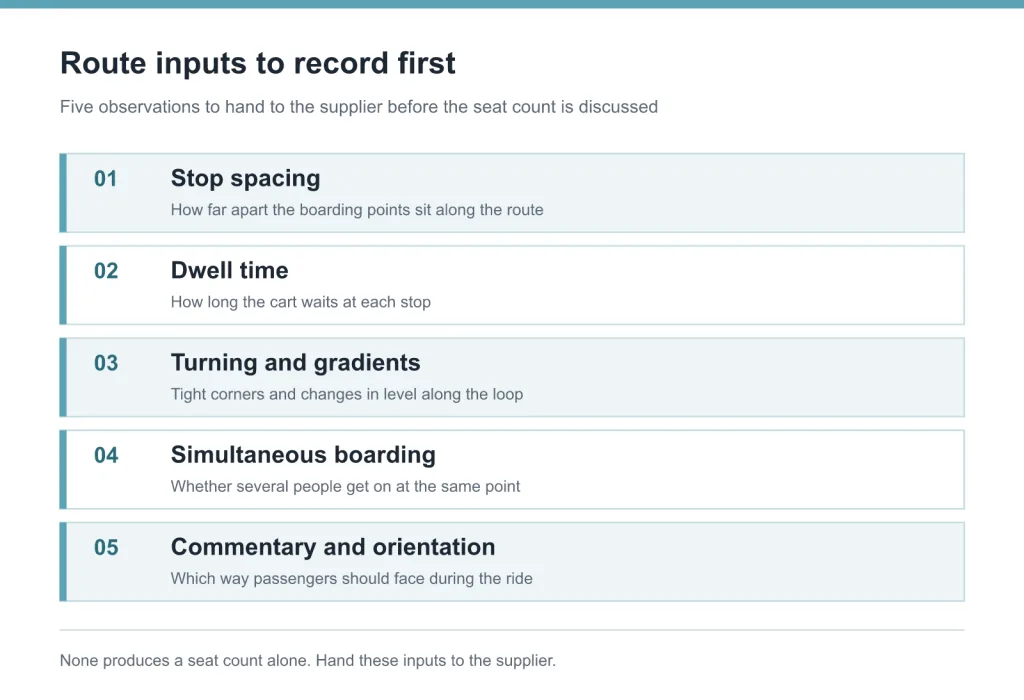
Stop spacing: distance between boarding points and dwell at each. Frequent stops weight boarding flow; long gaps weight how passengers face during the ride.
Dwell time: how long the vehicle waits at each stop, including loading and unloading. It sets how many groups one vehicle can cycle through.
Turning and gradients: tight corners, narrow lanes, slopes. Record them as route facts, not as reasons to pick a count yourself.
Simultaneous boarding: how many people present at a stop at once, especially at arrival peaks. Treat it as an input, not a recommendation.
Commentary and orientation: whether a guide addresses the group and which way passengers should face to follow it or a view.
Write each as a measurable note. None produces a seat count alone; they are what the supplier needs. A seating configurations explainer frames the codes once the route is described.
2. Decode the layout code
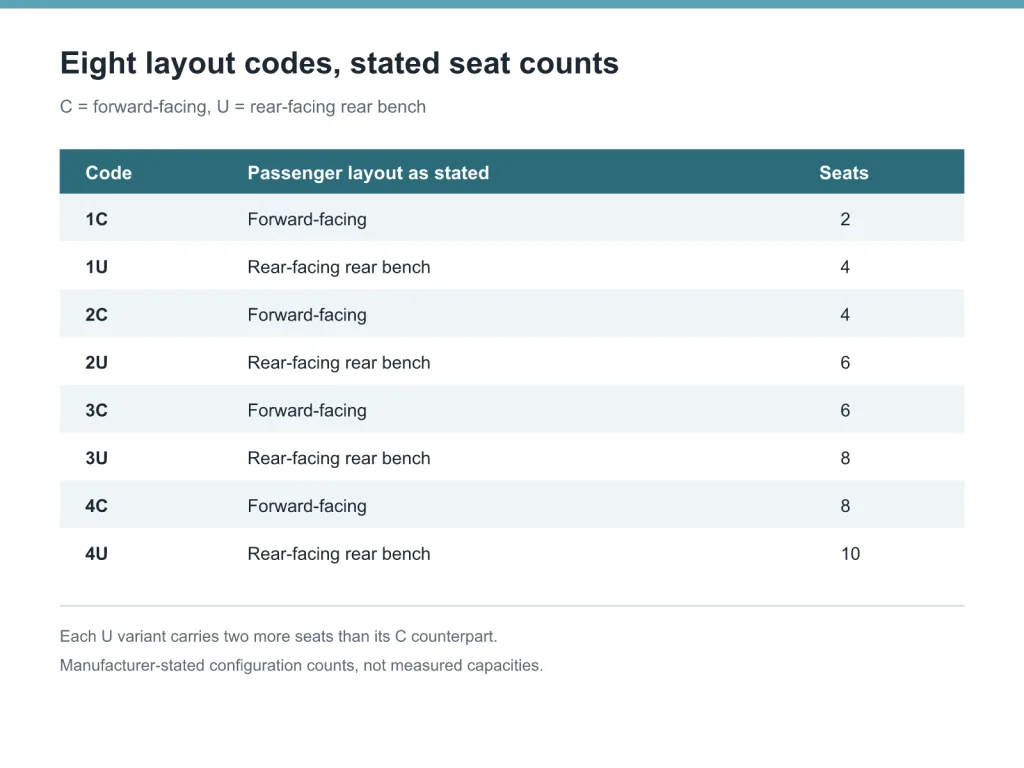
Both product pages state eight layout codes. C means forward-facing; U means a rear-facing rear bench. Counts below are manufacturer-stated.
| Code | Passenger layout as stated | Seats (manufacturer-stated) |
|---|---|---|
| 1C | Forward-facing | 2 |
| 1U | Rear-facing rear bench | 4 |
| 2C | Forward-facing | 4 |
| 2U | Rear-facing rear bench | 6 |
| 3C | Forward-facing | 6 |
| 3U | Rear-facing rear bench | 8 |
| 4C | Forward-facing | 8 |
| 4U | Rear-facing rear bench | 10 |
Read the code as a pair: number plus letter. Across the eight codes, each U variant carries two more seats than the C variant in the same family. That helps you read a code, not choose one. The pages give seat counts only, no body dimensions or measured capacities.
3. What forward-facing and rear-facing each serve
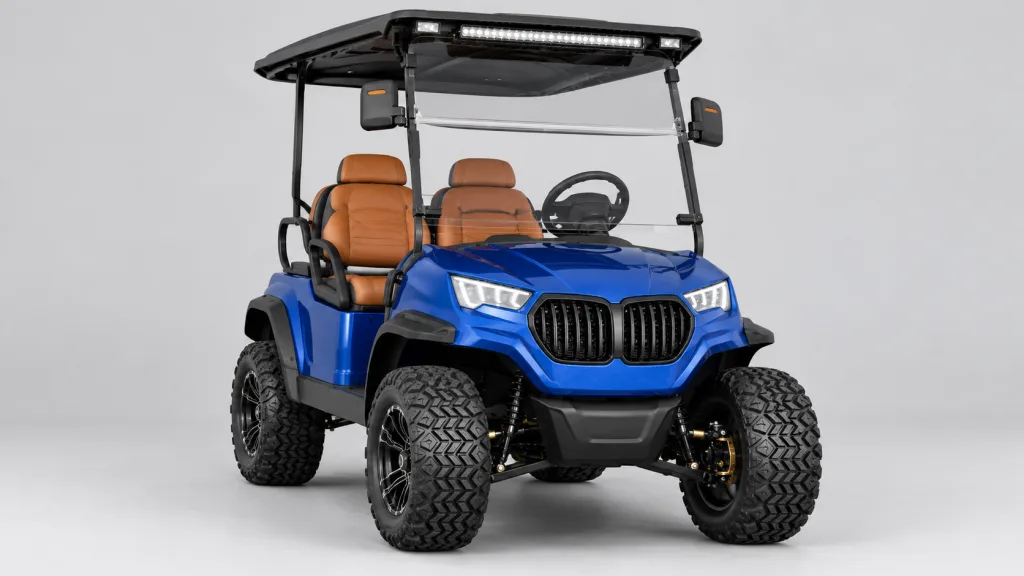
Forward-facing seating points passengers along the direction of travel. Where a guide at the front gives commentary, the group follows the same sightline as the guide. Record how groups board at a peak stop and whether the forward rows change that flow.
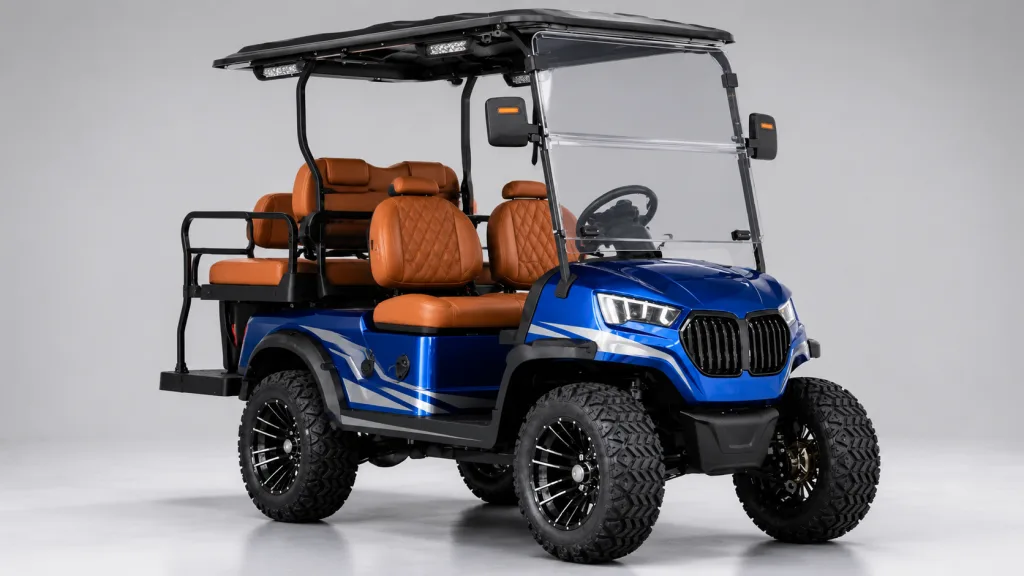
A rear-facing rear bench changes the view. Passengers on it face back along the vehicle, so the guide addresses them differently. Where the point of interest lies behind the direction of travel, or passengers travel in pairs and talk across the cabin, raise that arrangement with the supplier. It also changes where the guide stands to be heard.
Neither orientation is a verdict. The operating questions are the same: where the guide sits, how commentary is delivered, how groups board, and where bags go. Answer those from the route notes, then match a code.
4. Four route examples, stated as method
These cases show the method. Each ends with inputs to confirm, not a seat count to copy.
Resort shuttle. Link reception, rooms, and a pool or beach point. Record stop spacing, dwell, and simultaneous boarding at check-out or breakfast, then ask whether a driver gives commentary. For vehicle context, see resort and hotel transport.

Campus loop. Class-change peaks and tight turns near buildings. Log the corners and how many people present at a stop at once; a campus and estate transport reference frames the setting. Ask how chosen codes behave at peaks, not which code fits a campus in general.
Estate tour. A slower pace with dwell at viewpoints and commentary throughout. Record where the guide needs passengers to face and the gradients between stops; fix orientation before discussing codes.
Rental mixed fleet. Groups of changing size and short turnaround. Record the spread of group sizes, the turnaround process, and how vehicles are reassigned. Ask the supplier how much variety the operation can absorb.
5. Mixing codes on one platform
Keeping several codes on one platform is an operations choice. Spares, service routines, and staff training can be shared from one platform; confirm that with the supplier.
Spares and service. Ask which parts are common across the codes you are considering and which differ. The pages publish no parts list, so record the answer against your own plan.
Wrap and finish. Where vehicles carry a wrap or specified finish, ask how consistency is held across mixed codes and a production run. No numbers are given, so keep it as a written question.
Production schedule. Both pages mention minimum order quantities and production schedule but give no quantities or days. Ask for the written schedule for your mix and do not fill blanks from an estimate.
A fleet cost comparison can structure the ownership conversation, but not replace those answers. No price, savings, or payback figure is given here.
6. Seat count is separate from battery and plugs
Seat count, energy choice, and plug type are separate lines on a specification sheet.
Battery. The GF Classic page frames this as “Battery choice by duty cycle”, with Lithium or lead acid as the options. The phrase is by duty cycle, not by shift. Record your route’s duty cycle and ask which option fits; this article does not choose.
Charging plugs. The same page lists six plug types as “GB, US, GB, EU, ZA and IT”. Reproduced as stated, including the repeated GB. Ask which type applies to your configuration and site.

Range. The GF Classic page indicates tested figures are published in the specification sheet rather than quoted as a single headline number. Use the sheet for range discussions; no speed or range figure is stated on either page.
The GF Sport page lists no plug types or battery options, and the GF Classic page has no GF Utility / GF Trail handoff. Keep those boundaries when comparing them.
7. When a route exceeds the platform
The pages tie wheel size to ride geometry in one line: “Wheel size affects ground clearance and ride height”. No numeric figure follows, so treat it as a qualitative note to raise with the supplier.
Where a route calls for more than the platform suits, the GF Sport page directs buyers to GF Utility / GF Trail. That is a handoff to another platform, not a promise about this one on a given surface. Record the conditions in writing and ask whether to continue here or move the conversation. Do not turn the handoff into a capability claim in either direction.
8. What to confirm in writing before ordering
Before ordering, ask for written answers to these.
- The route record: stop spacing, dwell time, turns and gradients, simultaneous boarding, commentary orientation.
- Each proposed code mapped to its stated seat count, and how the supplier reads the code family.
- How forward and rear-facing seating affect guiding, boarding, and equipment storage on your route.
- Which parts are common across your codes and which differ.
- How wrap or finish consistency is held across a mixed-code run.
- The written production schedule for your mix, with no assumed quantities or days.
- The duty-cycle battery option and the plug type for your configuration, as stated on the page.
- Where tested range figures are published, and that no single headline number is used.
- The position if route conditions exceed the platform, including whether GF Utility / GF Trail is the next step.
Place those beside your logged route record. Neither a code mapping nor a plug list answers fit on its own.
Frequently asked questions
Should I choose seating from the peak number of guests?
No. Both product pages state 2 to 10 seats across eight layout codes but do not say which fits a given route. Start from the route profile: stop spacing, dwell time, turns and gradients, simultaneous boarding, and whether a guide gives commentary. Hand those inputs to the supplier and ask for a code recommendation. This article gives the method and the inputs, not a universal seat count.
What do the C and U in a layout code mean?
C means forward-facing and U means a rear-facing rear bench, as stated on both pages. The stated mapping is 1C for 2 seats, 1U for 4, 2C for 4, 2U for 6, 3C for 6, 3U for 8, 4C for 8, and 4U for 10. Each U variant carries two more seats than its C counterpart. These are manufacturer-stated configuration counts, not measured capacities.
Can I read the seat limit from the model name or the URL?
No. The GF Sport URL contains a 6-seater slug, while the page title and body both state 2 to 10 seats. The slug is a historical label and not a seat limit. Read the stated range and confirm the configuration in writing; do not infer capacity from a URL.
How are battery type and charging plugs decided?
They are separate from the seat count. The GF Classic page frames battery choice by duty cycle, with Lithium or lead acid as the options, so record the duty cycle rather than a shift label. The page lists six plug types as GB, US, GB, EU, ZA and IT; the repetition is reproduced from the page. Ask the supplier which plug type and battery option suit your configuration.
What if my route is steeper or rougher than the platform suits?
The pages state that wheel size affects ground clearance and ride height but give no numeric figure. When route conditions exceed the platform, the GF Sport page directs buyers to GF Utility / GF Trail. Treat that as a handoff, not a performance promise in either direction. Record the conditions and ask the supplier in writing whether to stay or move the conversation.
Notes
All seating figures here are manufacturer-stated specifications from the GF Classic and GF Sport product pages, not third-party measurements or industry-wide values. No registration, road-use, or approval conclusion follows.
The 2 to 10 seat range, eight codes, and per-code seat counts are stated on both pages. Neither page states a speed, driving range, body dimension, or numeric ground clearance. “Wheel size affects ground clearance and ride height” is a qualitative line, not a measurement.
Both pages mention minimum order quantities and production schedule but give no quantities or days. This article supplies no MOQ, lead time, price, savings, payback, or battery-life figure.
The GF Classic page lists six plug types as “GB, US, GB, EU, ZA and IT”, reproduced verbatim with the repeated GB; it is not corrected or reinterpreted as six national standards. That page frames battery choice as “Battery choice by duty cycle”, with Lithium or lead acid as the options, and says tested figures are published in the specification sheet rather than as a single headline number.
The GF Sport page lists no plug types or battery options, and the GF Classic page has no GF Utility / GF Trail handoff. The GF Sport URL slug contains “6-seater”, but the title and body state 2 to 10 seats; the slug is historical and not a seat limit, and it is not used to infer capacity.
“Manufacturer-stated” is the wording of these Notes, not a phrase on the pages. No absolute claim about a route or configuration is made. The article offers a method, an input list, and a written question list only.