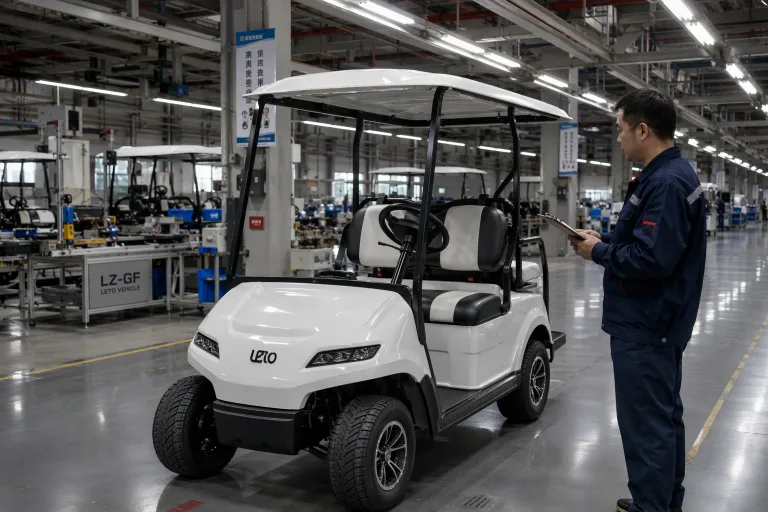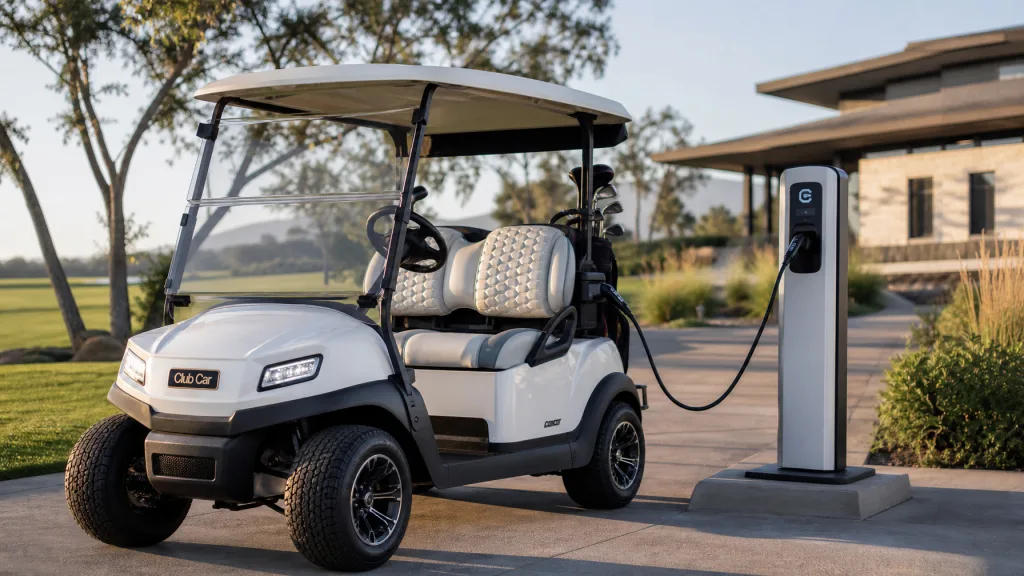
A five-year total cost of ownership (TCO) comparison estimates what an electric or gas golf cart will cost to buy and operate over the same five-year period. It is a budgeting window, not a prediction of how long a cart, battery, or engine will last. The result depends on the purchase quote, use pattern, local electricity and fuel prices, maintenance requirements, charging or refueling setup, and resale assumptions. There is no universal winner: the useful comparison is the one built from the buyer’s actual route, workload, service access, and local prices.
The short version
- Compare the same vehicle class, passenger or cargo configuration, duty cycle, and five-year period. A different seating layout or workload can distort the comparison before energy costs are considered.
- Estimate annual electricity or fuel from measured or manufacturer-supported consumption under the intended operating conditions, then multiply by the buyer’s local tariff or fuel price.
- Include scheduled service and expected wear items using the exact vehicle’s maintenance schedule and local labor and parts quotes. A Club Car checklist, for example, lists some powertrain-specific items as well as checks common to all vehicles [1].
- Add purchase and setup costs, including charging equipment or electrical work where needed. Do not assume the charging point already exists or is free to install.
- Keep battery, engine, and other major replacement costs as explicit scenarios unless a written supplier quote or applicable warranty establishes the treatment. A five-year model does not establish that a component will or will not need replacement.
- Show residual value separately. If no defensible resale evidence is available, compare costs before resale and disclose that limitation rather than inventing a resale percentage.
- Recalculate with local inputs. A cost calculator’s categories can help structure the model, but published passenger-car or light-duty vehicle figures are not golf-cart cost data [2].
1. Define the comparison before collecting prices
Start with two vehicles that perform the same job. Match passenger capacity, cargo configuration, tires, ground clearance, accessories, and operating site as closely as possible. If one quote includes a charger, weather enclosure, or upgraded battery and the other does not, list those differences instead of treating the quoted prices as like-for-like.
Next, describe the work. Record operating days per year, hours or distance per day, typical load, terrain, stop frequency, gradients, ambient conditions, and whether the cart returns to a known charging location. For a golf course, an estate, a resort, or a campus, the route and daily schedule can differ substantially. Use logs from the current fleet if available; otherwise mark the estimate as provisional and measure a representative operating period before committing to a large order.
The five-year window should be applied to both options consistently. Do not describe it as the expected service life of either powertrain. The model answers: “What costs do we expect to incur during this defined period under these assumptions?” It does not answer how many years a battery or engine will last.
2. Build the five-year cost model
Use one currency and one price date throughout. For each vehicle, calculate the same categories:
| Cost category | Electric cart | Gas cart | Buyer input to collect |
|---|---|---|---|
| Initial purchase | Quoted vehicle, battery configuration, accessories, delivery, and commissioning | Quoted vehicle, engine configuration, accessories, delivery, and commissioning | Comparable written quotations |
| Energy | Annual kWh consumed × local electricity price, adjusted for charging losses if supported by data | Annual fuel consumed × local fuel price | Measured or documented consumption and local tariff or pump price |
| Routine maintenance | Model-specific inspections, battery-related tasks where applicable, tires, brakes, steering, and other scheduled items | Model-specific engine and drivetrain service, tires, brakes, steering, and other scheduled items | Owner’s manuals, service intervals, parts and labor quotes |
| Setup and operations | Charger, wiring, electrical upgrades, charging-area work, and any separately billed energy demand charges | Fuel storage or dispensing equipment, site work, and any required operating arrangements | Site survey and supplier quotes |
| Ownership and financing | Applicable acquisition fees, insurance, and financing charges, if included | Applicable acquisition fees, insurance, and financing charges, if included | Local fee schedule, insurance quote, financing terms; do not count loan principal twice |
| Repairs and replacements | Separate scenario for a major battery, charger, motor, or controller event | Separate scenario for engine, transmission, fuel-system, or other major repair | Warranty terms, exclusions, supplier quote, service history |
| End-of-period value | Estimated resale or trade-in value, if supported | Estimated resale or trade-in value, if supported | Comparable used-vehicle evidence or a written buyback offer |
A simple undiscounted comparison is:
Five-year net cost = initial purchase and setup + five-year energy + five-year maintenance and repairs + included ownership and financing costs - end-of-period resale value
For year-by-year detail, calculate the annual operating costs separately and add them to the initial costs. Buyers who use a financial discount rate can also convert future expenses to present value, but they should use the same rate and timing assumptions for both options. The Department of Energy’s Alternative Fuels Data Center describes a similar cost-category approach for its vehicle calculator, including fuel or electricity, maintenance and tires, and acquisition-related costs. Its published methodology also identifies costs it excludes, such as charging-system purchase and installation and trade-in value. The calculator is a high-level tool for the vehicle models it covers; it does not provide golf-cart-specific prices or consumption values [2].
Avoid double counting. If a dealer quote includes delivery or commissioning, do not add those items again. If a maintenance contract covers labor and parts, model the contract price instead of also counting the covered services individually. Document whether a quoted electricity rate includes taxes, demand charges, or time-of-use pricing.
3. Estimate energy from the actual duty cycle
For an electric cart, a basic annual electricity estimate is:
Annual charging cost = annual kWh drawn from the supply × local electricity price per kWh
Use the cart’s documented energy consumption for a comparable duty cycle, or measure energy delivered at the charger over representative shifts. If the available figure is battery-side energy rather than energy drawn from the supply, account for charging losses only when there is a reliable measurement or technical basis. Record whether the cart is charged after each shift, overnight, or during breaks, and whether the schedule requires more than one charger per vehicle.
For a gas cart, a basic annual fuel estimate is:
Annual fuel cost = annual operating hours × measured fuel use per hour × local fuel price
If the manufacturer supplies fuel consumption in another unit, preserve that unit consistently and convert it transparently. Do not infer golf-cart consumption from a passenger car’s fuel-economy rating. Where available, track refills and engine hours for a representative period, and separate fuel used for routine work from unusual events or idling.
The comparison can change with utilization. Low annual use limits the amount of energy cost that can offset a higher initial purchase price. More intensive operation makes the energy line more consequential, but it does not guarantee that one option has the lower total cost: purchase price, maintenance, setup, and resale still matter. Test at least a low, expected, and high use case rather than presenting one forecast as certain.
4. Compare service requirements without overgeneralizing
Electric and gas carts do not have identical service checklists. Club Car’s published guidance lists engine oil, air-intake and air-filter work, and belts or hoses for gas vehicles; its electric checklist includes battery and cable checks. The same guidance also lists shared checks such as tires, steering, braking, and vehicle condition [1]. That is useful for identifying categories to ask about, not a universal maintenance schedule for every make, model, or battery type. The Club Car page also directs owners to the model-specific owner’s manual for vehicle care and storage [1].
Use the exact owner’s manual for each quoted configuration. Convert each scheduled task into an annual or five-year cost using local parts and labor rates. Ask the supplier to identify what is included in the quoted service package, what is a wear item, and what is excluded from warranty coverage. For an electric vehicle, clarify battery chemistry, inspection requirements, charging practices, warranty coverage, exclusions, and the quoted replacement cost if available. A replacement price is a scenario input, not a prediction that replacement will occur within the comparison period.
For a gas vehicle, request the maintenance intervals and costs for the specific engine and drivetrain. Do not assume that every gas cart has the same service schedule, fuel use, or parts availability. If access to a qualified technician differs between the two configurations, record travel, downtime, and service-call costs rather than hiding them in an unsupported “maintenance savings” estimate.
A separate golf cart maintenance schedule may help buyers prepare a service checklist, while golf cart battery lifespan addresses battery assessment and replacement decisions. Those subjects should not be turned into a lifespan promise in this five-year comparison.
5. Include the site, charging, and downtime
A charging location has a real cost even when electricity is inexpensive. Confirm connector compatibility, charger output, electrical capacity, installation work, cable routing, weather protection, and the number of carts that must charge at the same time. If a site needs upgraded electrical service or additional charging points, use a site-specific quotation and show that cost separately from the vehicle price. For a fleet, refer to golf cart charging infrastructure when estimating charger quantity, layout, and operating schedule.
Gas carts also depend on an operating setup: fuel access, secure storage where applicable, delivery arrangements, and staff time for refueling. Include only costs that apply at the buyer’s site, and document the source. This is especially important when comparing a single cart with a fleet, because shared equipment may be allocated across several vehicles. State the allocation method and test whether it changes the result.
Downtime can affect operations even when it is not a direct invoice. If the buyer wants to quantify it, use a documented replacement-vehicle rental cost, service-call charge, or internal cost per unavailable operating hour. Apply the same method to both options. Do not assign a speculative productivity value to one powertrain alone.
6. Treat uncertainty as a result, not a footnote
The model’s output is only as strong as its inputs. Prepare a base case with documented quotes and usage, then vary the assumptions most likely to change the decision: annual hours or distance, electricity and fuel prices, service costs, charging setup, and resale value. Where a major component replacement is uncertain, show at least two cases, such as “no replacement during the window” and “replacement cost included,” without assigning an unsupported probability.
A useful procurement summary should show the total for each option, the difference between them, the largest cost drivers, and the assumptions that would reverse the result. For example, state the annual utilization at which the modeled energy-cost difference equals the initial-price difference, if that break-even point can be calculated from verified inputs. Call it a model result under stated assumptions, not a guaranteed payback period.
If reliable resale evidence is unavailable, show the comparison both before residual value and with any separately sourced residual estimate. The AFDC methodology explicitly notes that trade-in value and charging-system purchase and installation are excluded from its calculator assumptions; this is a reminder to check scope, not a reason to reuse its values for golf carts [2]. Likewise, do not transfer its light-duty vehicle maintenance figures or historical assumptions to a golf-cart purchase.
7. What to request before choosing
Ask each supplier for a written quotation that identifies the exact model and configuration, included accessories, delivery and setup, warranty coverage, maintenance schedule, recommended parts, and service availability. Request energy or fuel consumption information with its test conditions, not just a headline range or efficiency claim. For electric carts, clarify whether the battery and charger are included and obtain a separate installation estimate if the site is not ready. For gas carts, clarify the fuel type, scheduled engine service, and local parts support.
Then insert local prices and operating data into the same five-year worksheet. Keep source documents and assumptions alongside the totals so the comparison can be updated when tariffs, fuel costs, supplier quotes, or operating patterns change. The procurement decision should follow the buyer’s duty cycle and site constraints; neither “electric” nor “gas” is, by itself, a complete cost conclusion.
Frequently asked questions
Is an electric golf cart always cheaper over five years?
No. The result depends on the purchase and setup costs, actual energy use, local electricity and fuel prices, maintenance requirements, utilization, and resale assumptions. Calculate both options with the same duty cycle and disclose the inputs rather than relying on a general claim.
Does a five-year TCO mean the cart or battery will last five years?
No. Five years is only the comparison period used in the budget model. It is not a service-life estimate or a guarantee for the vehicle, battery, engine, or any other component. Use the relevant warranty, maintenance schedule, and supplier documentation for those questions.
Should battery replacement be included in the electric-cart estimate?
Include a replacement cost when a reliable, configuration-specific quote is available, but show it as a separate scenario unless evidence supports treating it as a planned cost during the period. A cost model should not imply that replacement is certain or unnecessary merely because its horizon is five years.
Can I use an online vehicle cost calculator for a golf cart?
Use a calculator to understand cost categories and calculation structure, but first check which vehicles and assumptions it covers. The AFDC Vehicle Cost Calculator is a high-level tool for the models it supports and does not provide golf-cart-specific operating or purchase data. Replace its inputs with local golf-cart quotes and measured or documented consumption.
What is the most important input to verify first?
Verify the operating profile and comparable energy-consumption data. Annual use determines how often energy and service costs accrue, while consumption measured or documented for the intended workload is more useful than a figure from a different vehicle class or test condition.
Sources
- Club Car. Cleaning, Disinfecting, & Maintaining Club Car Golf Carts, UTVs. n.d. Cited 5 November 2026. https://www.clubcar.com/en-us/resources/vehicle-cleaning-disinfecting-and-maintenance-guidelines. Notes: The checklist distinguishes gas-vehicle, electric-vehicle, and all-vehicle items; consult the specific owner’s manual for the applicable schedule.
- U.S. Department of Energy, Alternative Fuels Data Center. Vehicle Cost Calculator Assumptions and Methodology. n.d. Cited 5 November 2026. https://afdc.energy.gov/calc/cost_calculator_methodology.html. Notes: Used only as a framework for cost categories and scope disclosure; the tool covers the vehicle models it supports and is not a golf-cart cost dataset. Its methodology page describes assumptions and exclusions that should not be transferred as cart-specific inputs.