
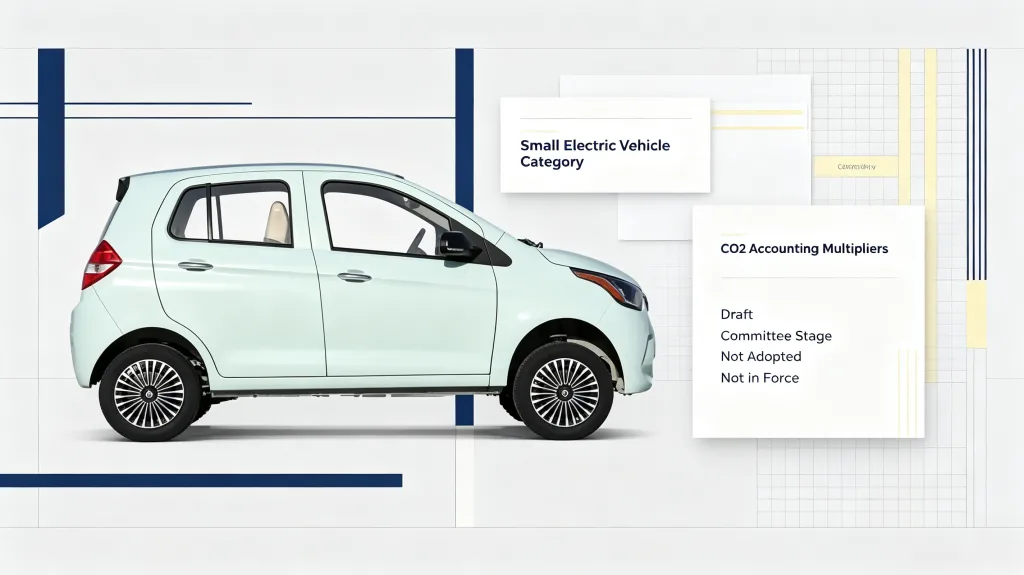
An EU small electric vehicle category is a proposed class of passenger cars in two committee-stage drafts reported by the European Parliament in November 2026. It is not an adopted rule, and it is not in force. The drafts came from different committees, were adopted in separate votes, and describe different things: one proposes a new category of small electric vehicles, the other CO2 accounting multipliers for clean vehicles. For a business that imports or distributes such vehicles, the question is whether to wait for the new category or to keep working with the existing route under the EU L-category type-approval framework. This article sets out what the drafts say, what they leave open, and a method for deciding what to verify and with whom. It is an industry update, not a compliance interpretation, and gives no instruction to wait or to switch.
The short version
- Two separate European Parliament press releases, both dated 04-11-2026, report committee-stage drafts: one on a proposed small electric vehicle category, the other on revised CO2 emissions targets and incentives.
- They are not the same vote. The first was adopted by the Environment, Internal Market and Transport Committees, 105 in favor, 39 against, 21 abstentions [1]. The second was adopted by the Environment Committee, 48 in favor, 30 against, two abstentions [2].
- Both are drafts, neither adopted law or in force. The mandate for negotiations with EU governments is expected to be voted during the December 2026 plenary session [1] and [2].
- The 1.4 and 1.2 multipliers, and 1.5 and 1.3 under social leasing, are used in calculating a manufacturer’s average specific CO2 emissions. They are not a buyer subsidy, price discount, tariff benefit, or registration convenience [2].
- The first release describes the category as passenger cars of maximum length 4.2 meters and says “made in the EU” is “to be defined under the Industrial Accelerator Act” [1]. No definition is given.
- L6e and L7e belong to the EU L-category type-approval framework. The releases describe the new category as passenger cars and do not state any relationship to that framework.
- This is a decision framework, not a procurement conclusion. Confirm the supplier’s type-approval documents, check with the competent authority in the destination country, and monitor subsequent official publications.
1. Two press releases, two committees, two votes
The November 2026 material is not one document but two separate European Parliament press releases, published minutes apart on 04-11-2026, each reporting a different committee-stage draft. Keeping them distinct matters, because the committee names, the vote totals, and the subject matter all differ.
The first release, timestamped 14:51 and titled “Automotive sector: boost electric vehicles, simplify measures”, reports a joint draft from three committees. It states:
“Parliament’s Environment, Internal Market and Transport Committees suggest simplifying and improving certain rules governing the EU automotive industry.” [1]
It records the vote on those draft rules:
“The draft rules, adopted with 105 votes in favour, 39 against and 21 abstentions on Wednesday, are part of a broader package aimed at supporting the automotive sector in the transition to clean mobility.” [1]
The 105/39/21 figures belong to a draft associated with the Environment, Internal Market and Transport Committees together. This is not a plenary vote, and not a vote on the second release.
The second release, timestamped 15:35 and titled “CO2 emissions: adjusted targets, more incentives for clean vehicles”, reports a separate draft from a single committee:
“On Wednesday, Parliament’s Environment Committee adopted its proposal for revised CO2 emissions targets for new cars and vans and incentives for clean vehicles made in the EU.” [2]
It gives a different vote:
“Adopted with 48 votes in favour, 30 against and two abstentions, the draft rules are part of a broader package for a clean and competitive European automotive sector.” [2]
Here the figures are 48 in favor, 30 against and two abstentions, and the body is the Environment Committee alone. This release spells the abstentions as “two”, not a digit [2]. Both texts are described as draft rules in the source, so committee approval is not adoption into law. A citation should point to the specific release behind each claim, rather than blending the 105/39/21 and 48/30/two figures into one result.
2. Where the drafts sit in the procedure
Both texts are committee-stage drafts. Adoption by committees is a real procedural step, but it is not the same as the EU adopting a law. Neither release presents the texts as adopted law, and neither gives a date from which the rules apply. The language stays conditional: draft rules, agreed proposals, measures that would take a certain form.
Both releases contain the same forward-looking sentence:
“Parliament’s mandate for negotiations with EU governments is expected to be voted during the December 2026 plenary session.” [1]
The identical sentence appears in the second release [2]. It describes an expected vote on Parliament’s negotiating mandate at the December 2026 plenary session, a scheduled procedural step reported as an expectation, not a prediction of a result. After that step, the described path is negotiations with EU governments. That is as far as the two press releases take the procedure: committee adoption of draft rules, an expected plenary vote on the mandate, and then negotiations with EU governments.
The releases do not state the result of the December plenary vote, the outcome of those negotiations, or an entry-into-force date. Any claim that the vote or the negotiations have a known result, or that the rules apply from a given date, goes beyond the sources. The accurate status for record-keeping is: committee-stage proposals, a December plenary vote on the negotiating mandate expected, and negotiations with EU governments to follow; the final text and any timeline are not established here.
3. What the draft says about small electric vehicles
The category appears in the first press release, in a sentence that also carries the qualifications a reader needs:
“To encourage the development and market uptake of electric vehicles, the MEPs agreed to introduce a new category of “small electric vehicles” – passenger cars of maximum length 4.2 metres and made in the EU (to be defined under the Industrial Accelerator Act).” [1]
Read literally, the draft is an agreement to introduce a new category, which is a proposal, not a category already in law. The vehicles are described as passenger cars of maximum length 4.2 meters. The phrase “made in the EU” is qualified in the same sentence by “to be defined under the Industrial Accelerator Act”, so the press release does not itself supply a definition, and no definition appears in either release.
That point is easy to overread. The text does not say which vehicles count as made in the EU, whether vehicles assembled in the EU qualify, whether component origin matters, or how a non-EU manufacturer is treated. It does not mention imported vehicles or non-EU manufacturers at all. Those are open questions the source defers to a separate act, so no conclusion about whether a given imported vehicle is inside or outside the category can be drawn from these press releases.
The same release mentions a related mechanism, in wording that preserves the original CO₂ character:
“The measures would also include a super-credit mechanism under the update of the CO₂ emission performance standards.” [1]
Note the conditional “would also include”, and that this mechanism is tied to the CO₂ emission performance standards, whereas the second release uses CO2 in its title and text. The difference is preserved deliberately: the first release writes CO₂, the second writes CO2. That is a feature of the sources, not a spelling choice to smooth over.
4. The multipliers are accounting figures, not buyer incentives
The second press release describes a mechanism whose numbers are often summarized as “1.4 times” or “1.5 times”. The mechanism is worth quoting in full, because the figures mean something specific:
“In calculating a manufacturer’s average specific CO2 emissions, small EVs (having a maximum length of 4.2 metres and made in the EU) would count as 1.4 vehicles, and highly efficient EVs (made in the EU and meeting strict electric energy consumption thresholds) as 1.2 vehicles, MEPs say.” [2]
“If vehicles are registered under a social leasing scheme, the multipliers would be increased by 0.1, to 1.5 and 1.3 respectively.” [2]
The operative phrase is “In calculating a manufacturer’s average specific CO2 emissions”. These are multipliers applied inside the arithmetic used to compute a manufacturer’s fleet-average CO2 emissions. A small EV would count as 1.4 vehicles in that calculation, and a highly efficient EV as 1.2; under a social leasing scheme the multipliers would be 1.5 and 1.3. They describe how a vehicle is weighted in an emissions calculation, not a transaction with a buyer.
That distinction is worth stating plainly, because the numbers are easy to misread. The 1.4, 1.2, 1.5 and 1.3 figures are not a subsidy paid to a buyer, not a discount on the vehicle price, not a tariff or duty reduction, and not a registration convenience or a shortcut to street legality. None of those appears in the press release. They are weights in an emissions-accounting formula, attributed to “MEPs say” and framed with “would count”, not with a statement that they already apply. The same release uses future-conditional wording elsewhere, for a 3% low-carbon steel credit cap running from the entry into force of the rules until the end of 2034, which reinforces that the text remains a draft and gives no application date.
5. The new category and the L-category framework are described separately
A reader could easily connect two things the sources do not connect. The first release describes the proposed new category as passenger cars. L6e and L7e, by contrast, belong to the EU L-category vehicle type-approval framework, a separate classification for light vehicles. The EU whole-vehicle type approval often called homologation is a distinct body of rules from the passenger-car CO2 framework the second release addresses.
The conservative reading supported by the sources is this: the releases describe the new category as passenger cars, and they do not state its relationship to the L-category framework. They do not say that the new category replaces L6e or L7e, that L-category vehicles are exempt from it, that the two frameworks are linked, or that an approval under one framework carries over to the other. A reader should therefore not infer a substitution, an exemption, or a bridging rule from the fact that both concern electric vehicles of limited size.
Readers who work with these classes can consult the EU type-approval guide for L6e and L7e and how to choose between L6e and L7e for the framework currently in place; those guides describe the existing classification, not the proposed category. Where a catalog includes both golf carts and low-speed vehicles, the difference between an electric golf cart and an LSV is a separate, product-level question.
It also helps to treat the regulatory layers as parallel requirements rather than a chain of substitutions. In EU practice, homologation, registration, and street legality are separate questions each needing confirmation; one does not exempt or replace another. Whether a particular model is street legal in a specific country is a status determination to confirm with that country’s authority, a different matter from the general subject of street legality. The drafts change none of those layers, and this article does not interpret them.
6. A judgment method, not a procurement conclusion
The question the drafts raise is whether to wait for the new category to be defined or to continue with the route that already exists. This article does not answer that question, and offers no legal opinion or purchasing instruction. What it offers is a method: what to confirm, and with whom, before any decision is taken. The point is to replace an assumption drawn from a headline with checks against documents and authorities. None of the checks depends on guessing the outcome of the December plenary vote or the negotiations with EU governments.
| What to confirm | With whom | What it establishes |
|---|---|---|
| The supplier’s existing type-approval documents for the exact model and version | The supplier or manufacturer | Which approval the vehicle currently holds, and under which framework it was issued |
| The rules applicable where the vehicle is to be registered or sold | The competent authority in the destination country | Whether the current route is available for that model now, and what the authority requires |
| The final text and status of the proposed category, once the procedure advances | Subsequent official publications and gazettes | Whether a final text exists, what it says, and from when it applies, if it applies at all |
Each row is a check against a document or an authority, not a prediction. The first concerns what already exists: the type-approval documents for the exact model show the approval a vehicle currently holds. The second concerns the rules currently applicable where the vehicle is to be registered or sold; registration requirements in Europe are a distinct subject, and the competent authority in the destination country is the place to confirm what applies now. The third concerns a final text that does not yet exist: monitoring subsequent official publications and gazettes establishes whether one has been adopted and what it says, rather than treating a draft as a rule.
Two further checks help keep the file clean. Import classification and duty treatment are separate questions; LSV import duty and HS codes is a distinct subject from the proposed category. Documentation for the current route should be complete on its own terms, since common certification mistakes are worth avoiding regardless of the draft’s status. None of these checks tells a business to wait or to switch; each tells it what to verify and with whom.
7. What the drafts do not say
An industry update is as clear about absences as about content. The two press releases are short news items, not consolidated legal text. Their silences are worth listing explicitly:
- Neither presents the texts as adopted law or gives a date from which the rules apply.
- Neither defines “made in the EU” or states whether imported vehicles, non-EU manufacturers, or vehicles assembled in the EU are covered.
- Neither uses the phrases “imported vehicles” or “non-EU manufacturers”; the releases are silent on how importers are affected, so no conclusion either way should be drawn from them.
- Neither states a relationship between the new passenger-car category and the L-category framework, or the result of the December 2026 plenary vote and the negotiations with EU governments.
- Neither describes the 1.4, 1.2, 1.5 or 1.3 figures as a buyer subsidy, price discount, tariff benefit, or registration convenience.
When a source does not define a term, state a relationship, or give a timeline, the responsible response is to record that it is silent and to identify who can answer later: the supplier for its documents, the destination-country authority for current rules, and subsequent official publications for any final text.
Frequently asked questions
Is the EU small electric vehicle category now in force?
No. Both texts are committee-stage drafts, not adopted law, and neither is in force. The two press releases describe draft rules and say that the mandate for negotiations with EU governments is expected to be voted during the December 2026 plenary session. Committee approval is not adoption into law.
Are the 1.4 and 1.2 figures a subsidy or a discount for buyers?
No. They are multipliers used in calculating the average specific CO2 emissions of a manufacturer, as described in the committee-stage draft. Small EVs would count as 1.4 vehicles and highly efficient EVs as 1.2 vehicles in that calculation. They are not a price discount, a purchase subsidy, a tariff benefit, or a registration convenience.
Did the two press releases come from the same committee vote?
No. One was adopted by the Environment, Internal Market and Transport Committees with 105 votes in favor, 39 against and 21 abstentions. The other was adopted by the Environment Committee with 48 votes in favor, 30 against and two abstentions. The vote totals belong to separate texts and should not be combined.
Do the drafts define what the phrase made in the EU means?
No. The press release describing the new category says the term is to be defined under the Industrial Accelerator Act and gives no definition. The drafts do not state whether the category covers imported vehicles, non-EU manufacturers, or vehicles assembled in the EU, so no conclusion about importers should be drawn from them.
Should an importer wait for the new category or use the existing L7e route?
This article does not give a procurement or legal conclusion. It offers a method: confirm the type-approval documents held by the supplier for the exact model, check the applicable rules with the competent authority in the destination country, and monitor subsequent official publications. Whether to wait is a decision to make with those documents and that authority, not from the press releases alone.
Sources
- European Parliament. Automotive sector: boost electric vehicles, simplify measures. 2026. Cited 13 November 2026. https://www.europarl.europa.eu/news/en/press-room/20261103IPR48611/automotive-sector-boost-electric-vehicles-simplify-measures. Notes: Committee-stage draft press release dated 04-11-2026 at 14:51. Joint Environment, Internal Market and Transport Committees; draft rules adopted with 105 votes in favor, 39 against and 21 abstentions. Source for the proposed “small electric vehicles” category (passenger cars of maximum length 4.2 meters, made in the EU, to be defined under the Industrial Accelerator Act), the super-credit mechanism under the CO₂ emission performance standards, and the expected December 2026 plenary vote on the negotiating mandate.
- European Parliament. CO2 emissions: adjusted targets, more incentives for clean vehicles. 2026. Cited 13 November 2026. https://www.europarl.europa.eu/news/en/press-room/20261103IPR48613/co2-emissions-adjusted-targets-more-incentives-for-clean-vehicles. Notes: Committee-stage draft press release dated 04-11-2026 at 15:35. Environment Committee only; draft rules adopted with 48 votes in favor, 30 against and two abstentions. Source for the 1.4 and 1.2 multipliers (and 1.5 and 1.3 under a social leasing scheme) in calculating a manufacturer’s average specific CO2 emissions, the low-carbon steel credit provision, and the expected December 2026 plenary vote on the negotiating mandate.