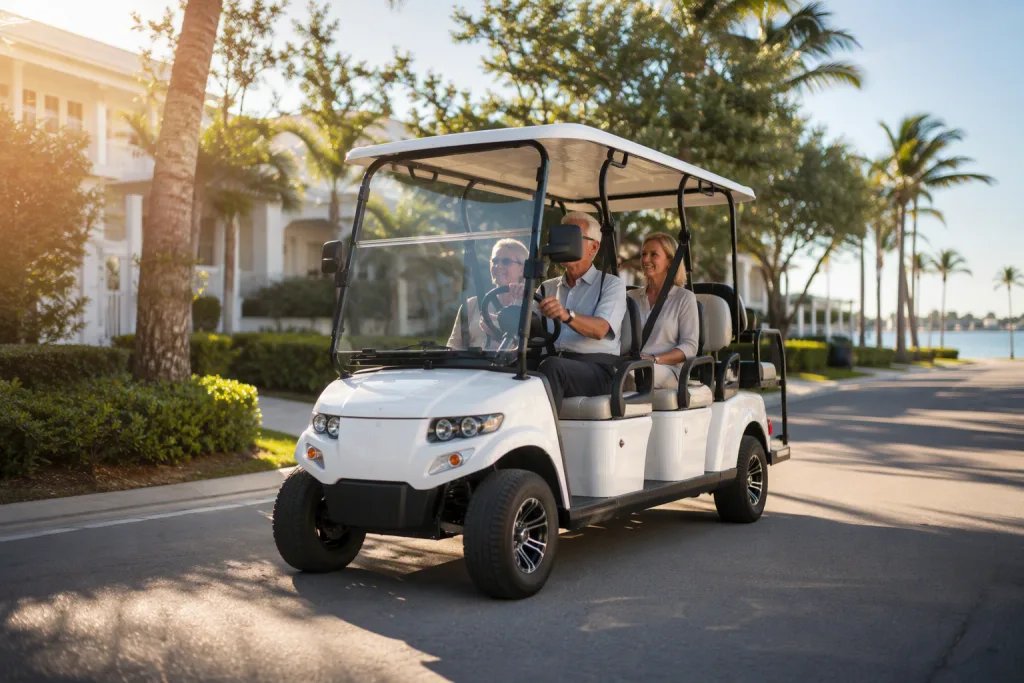
FMVSS 500 is the US federal safety standard that defines what equipment a low speed vehicle (LSV) must have before it can be operated on public roads. It requires twelve specific items of equipment, caps speed at 25 mph, and sets a GVWR ceiling of 3,000 lbs.
If you import electric vehicles into the United States, one number decides how your product is legally classified: 25 mph. Cross it, and the vehicle is no longer an LSV. Stay under it, and this standard tells you exactly what to install.
The short version
- FMVSS 500 sits at 49 CFR § 571.500 and applies to low speed vehicles operated on public roads
- An LSV must be four-wheeled, have a speed capability above 20 mph and not above 25 mph, and carry a GVWR under 3,000 lbs
- The standard requires twelve items of equipment, listed in S5(b)(1) through S5(b)(12)
- LSVs are exempt from federal crashworthiness standards; FMVSS 500 is an equipment standard, not a performance standard
- The windshield, VIN, and seat belts are each governed by separate standards (FMVSS 205, Part 565, FMVSS 209)
- Electric LSVs must also meet the alert sound requirement at § 571.141
- States regulate operation and registration separately. Four states do not permit LSVs on public roads at all
1. What FMVSS 500 is
FMVSS No. 500 is codified at 49 CFR § 571.500, titled “Standard No. 500; Low-speed vehicles.” It was established by the National Highway Traffic Safety Administration (NHTSA) in 1998.
The stated purpose, quoted directly from S2 of the standard:
“The purpose of this standard is to ensure that low-speed vehicles operated on the public streets, roads, and highways are equipped with the minimum motor vehicle equipment appropriate for motor vehicle safety.”
That single sentence sets two limits on how the standard should be read. It is an equipment standard, not a performance standard. It does not test how a vehicle handles, how it brakes in an emergency, or how it survives a collision. It specifies which lamps, mirrors, brakes, glazing, and identification numbers must be present.
The phrase “operated on the public streets, roads, and highways” scopes it as the federal floor for LSVs used on public roads. It is not the complete picture for any given vehicle, because individual states regulate operation, registration, and licensing separately.
Under 49 U.S.C. Chapter 301, a person may not “manufacture for sale, sell, offer for sale, introduce or deliver for introduction in interstate commerce, or import into the United States” any new motor vehicle unless the vehicle complies with all applicable FMVSSs. Importing an LSV into the US therefore triggers federal compliance requirements at the point of entry, not only at the point of sale.
2. The three-part LSV definition
Whether a vehicle qualifies as an LSV is determined by the definition at 49 CFR § 571.3. All three criteria must be satisfied simultaneously.
| Criterion | Requirement | Citation |
|---|---|---|
| Wheel count | Four wheels | 49 CFR § 571.3 |
| Speed capability | More than 32 km/h (20 mph) and not more than 40 km/h (25 mph) attainable in 1.6 km (1 mile) on a paved level surface | 49 CFR § 571.3 |
| Gross Vehicle Weight Rating | Less than 1,361 kg (3,000 lbs) | 49 CFR § 571.3 |
The speed window has a floor as well as a ceiling
The 20 mph floor is the part most importers miss. A vehicle that tops out at 18 mph does not meet the federal LSV definition, so it cannot be certified to FMVSS 500 standards at all. It falls outside that framework entirely. The floor becomes relevant when you modify a vehicle for a specific market, because removing a speed governor can push a compliant vehicle out of the LSV category.
GVWR is a rating, not a measurement
GVWR is the manufacturer’s declared value, not a number the importer discovers at the port. Under 49 CFR § 567.4(g)(3), the stated GVWR “shall not be less than the sum of the unloaded vehicle weight, rated cargo load, and 150 pounds times the number of the vehicle’s designated seating positions.”
The practical consequence: a six-seat vehicle with a 1,000 kg unloaded weight has a GVWR floor of 1,000 kg plus cargo rating plus 6 × 150 lbs (408 kg). If that total exceeds 1,361 kg, the vehicle cannot be an LSV as configured. Removing designated seating positions reduces the floor, which is why seat configuration affects legal classification and not only passenger capacity.
This is where the US definition is often confused with others. A standard golf cart sold for property use sits outside FMVSS 500 entirely, and the legal and practical difference between the two categories is set out in electric golf cart vs LSV. The European equivalent runs on a different classification system altogether, covered in L6e vs L7e type approval.
3. The speed limit rule and how it is tested
S5(a) of FMVSS 500 sets the performance limit:
“When tested in accordance with test conditions in S6 and test procedures in S7, the maximum speed attainable in 1.6 km (1 mile) by each low-speed vehicle shall not more than 40 kilometers per hour (25 miles per hour).”
The test itself, per S7: the maximum speed is determined by measuring the maximum attainable vehicle speed at any point in a distance of 1.6 km (1.0 mile) from a standing start, and the measurement is repeated in the opposite direction within 30 minutes.
Test conditions importers need to know
The speed limit only holds under the specific conditions NHTSA prescribes. A vehicle that passes under test conditions but exceeds 25 mph in other conditions is a compliance problem, which is why manufacturers document the governor setting rather than relying on the controller’s nominal limit.
| Condition | Requirement | Clause |
|---|---|---|
| Ambient temperature | 0 °C to 40 °C (32 °F to 104 °F) | S6.1.1 |
| Wind speed | Not greater than 5 m/s (11.2 mph) | S6.1.2 |
| Pavement friction | Peak friction coefficient of 1.02 using an ASTM F2493 reference test tire per ASTM E1337-19 at 64.4 km/h, without water delivery | S6.2.1 |
| Gradient | Not more than 1% in the direction of testing, not more than 2% perpendicular | S6.2.2 |
| Lane width | Not less than 3.5 m (11.5 ft) | S6.2.3 |
| Test weight | Unloaded vehicle weight plus 78 kg (170 lbs), including driver and instrumentation | S6.3.1 |
| Vehicle state | No adjustment, repair, or replacement of any component after the start of the first performance test | S6.3.2 |
| Tire pressure | Cold inflation pressure not more than the maximum permissible pressure molded on the tire sidewall | S6.3.3 |
| Break-in | Manufacturer’s recommended break-in agenda completed before testing | S6.3.4 |
| Openings | All doors, windows, hood, trunk, convertible top, and cargo doors closed except for instrumentation | S6.3.5 |
| Battery state of charge | As recommended by the manufacturer, or not less than 95% if no recommendation exists; no further charging permitted | S6.3.6 |
For electric vehicle importers, the state of charge floor is the clause to plan around. Because the floor is 95% unless the manufacturer specifies otherwise, a battery shipped at partial charge must be brought to the specified level before the speed test is valid.
4. The complete FMVSS 500 equipment list
S5(b) enumerates twelve required equipment items. This is the full list, with the governing standard cited for each.
| # | Required equipment | Governing standard | Notes |
|---|---|---|---|
| 1 | Headlamps | FMVSS 500 S5(b)(1) | None |
| 2 | Front and rear turn signal lamps | FMVSS 500 S5(b)(2) | Both front and rear required |
| 3 | Taillamps | FMVSS 500 S5(b)(3) | None |
| 4 | Stop lamps | FMVSS 500 S5(b)(4) | None |
| 5 | Reflex reflectors | FMVSS 500 S5(b)(5) | One red on each side as far to the rear as practicable, plus one red on the rear |
| 6 | Exterior mirror on the driver’s side, plus either an exterior mirror on the passenger’s side or an interior mirror | FMVSS 500 S5(b)(6) | Driver’s side exterior mirror is mandatory; the second requirement admits an interior mirror alternative |
| 7 | Parking brake | FMVSS 500 S5(b)(7) | None |
| 8 | Windshield conforming to the Federal motor vehicle safety standard on glazing materials | 49 CFR § 571.205 | Windshield glazing is governed by FMVSS No. 205, not by FMVSS 500 itself |
| 9 | VIN conforming to Part 565 Vehicle Identification Number Requirements | 49 CFR Part 565 | 17-digit VIN, separately regulated |
| 10 | Type 1 or Type 2 seat belt assembly at each designated seating position | 49 CFR § 571.209 (FMVSS No. 209) | Required at every designated seating position, not only the front |
| 11 | Rear visibility compliance | FMVSS No. 111 S6.2 | Cross-referenced to FMVSS No. 111 |
| 12 | Alert sound | § 571.141 | Minimum sound requirements for hybrid and electric vehicles |
Three items that are commonly missed
Seat belts at every designated seating position. S5(b)(10) applies to each designated seating position. A vehicle configured for rear passengers without rear seat belts does not comply, regardless of whether the rear seats are fold-up or removable. Because removing designated seating positions lowers the GVWR floor under 49 CFR § 567.4(g)(3), there is a direct regulatory relationship between seat count, GVWR, and seat belt installation.
The alert sound requirement. Item 12 references § 571.141, the quiet vehicle sound standard. Electric LSVs are subject to it. This is not optional for battery-powered vehicles.
Glazing and VIN are separately regulated. The windshield must conform to FMVSS No. 205 (49 CFR § 571.205), and the VIN must conform to Part 565. Complying with FMVSS 500 does not by itself satisfy either standard. You need documentation from the glass supplier and the VIN assembler. For an imported vehicle the VIN question is its own project, and 17-digit VIN requirements walks through how Part 565 applies when the vehicle was not originally built for the US market.
5. The crashworthiness exemption
This is the point that catches most importers out, and it is a deliberate feature of the standard rather than a loophole.
LSVs are exempt from most federal motor vehicle safety standards, and they are not required to meet any vehicle crashworthiness criteria. They are subject only to the limited equipment set listed in S5(b).
NHTSA confirmed this interpretation in a formal letter responding to state laws on medium speed electric vehicles (Interpretation ID: 07-005545as, April 29, 2008):
“As defined, LSVs are subject to the limited set of safety measures in Standard No. 500, including requirements regarding the installation of lamps, mirrors, seat belts, and a windshield. However, LSVs are not subject to the rigorous crashworthiness standards to which other vehicles are required to comply.”
The letter also draws a line that matters for product planning:
“Vehicles with a speed capability above 25 mph are more likely to be driven outside controlled, low speed environments, and the limited LSV safety requirements are not appropriate for such vehicles. A motor vehicle that has a speed capability above 25 mph, such as an MSEV with a top speed of 35 mph, would not be classified as an LSV under Federal law. Instead, the vehicles with a speed capability above 25 mph that would be considered MSEVs under the State laws at issue are classified as passenger cars, multipurpose passenger vehicles, or trucks under Federal law. These vehicles are subject to the full range of FMVSSs that apply to those classes of vehicles, including crashworthiness requirements in frontal, side, and rear crashes, braking requirements, lighting requirements.”
The letter also states that state laws do not alter federal classification: “regardless of State laws, the classification of a vehicle under Federal law remains unchanged.”
The commercial consequence
A vehicle designed to sit just under 25 mph can be homologated under FMVSS 500 as a street-legal LSV. A vehicle designed to reach 30 or 35 mph cannot, and becomes subject to the full federal crashworthiness suite as a passenger car, MPV, or truck. That is a fundamentally different homologation cost and timeline.
When you ask a supplier about a street-legal package, the useful follow-up question is: homologated to what standard, for which speed class, and for which destination market. A supplier who answers “street legal” without naming the standard has not answered the question. The configuration options that sit on the compliant side of that line are set out in street-legal LSV configuration.
6. Street-legal operation: state registration and licensing rules
Federal law classifies the vehicle. State law determines where it can be driven and what the operator needs. Getting this wrong is the most common reason a street-legal LSV still cannot be registered or operated as intended.
The general pattern across most states: LSVs may travel up to 25 mph on roadways with posted speed limits of 35 mph or less. Four states do not have statutes allowing LSV use on public roads: Connecticut, Mississippi, Montana, and Pennsylvania. Many states also allow their departments of transportation or local jurisdictions to restrict LSV use further, so municipal rules can be more restrictive than the state default.
California example
California Vehicle Code Section 385.5 illustrates how state rules layer on top of the federal equipment baseline. Registration is required when operating an NEV on a highway designated for such use by ordinance or resolution within one mile of a golf course. Operation on roads with speed zones above 25 mph is not permitted except by ordinance or resolution of a local authority. For operation anywhere other than private property, the vehicle must include at least one headlamp, tail lamp, and stop lamp, a rear reflector, front and rear turn signals, front and side reflectors, a mirror positioned to give the driver a rear view of at least 200 feet, a horn, fenders, a safety glazed windshield, and windshield wipers.
Note that several of these California items, including the horn, fenders, and windshield wipers, go beyond the FMVSS 500 equipment list. Federal compliance does not guarantee state compliance.
Because state rules vary this much, a vehicle that is street-legal in one jurisdiction may not be registrable in another. Street-legal LSV requirements by state breaks the position down state by state. The customs, freight, and entry steps that come before any of this are covered in importing electric golf carts to the US. Either way, before finalizing a configuration, tell us the destination country and, where applicable, the state or province, and we will confirm what documentation your project requires.
7. Two compliance traps importers should plan for
The GVWR seating trap
If a vehicle’s GVWR exceeds 3,000 lbs because of added seating, it cannot be certified as an LSV. NHTSA addressed this directly in its response to a petition concerning the 2012 Lita GLE-6 (Federal Register, December 9, 2014):
“Any vehicle not meeting the required GVWR for low speed vehicle (sic) must have some of the seating removed to achieve the correct calculated GVWR.”
NHTSA also addressed whether such a vehicle could be retrofitted into LSV compliance after manufacture:
“If the 2012 Lita GLE-6, as originally manufactured, had the characteristics of LSV but also has a GVWR of 3,000 pounds or more, then it would need to be classified as a motor vehicle of some type other than a low speed vehicle, such as a passenger car, multipurpose passenger vehicle, or truck. If the vehicle met one of those classifications, it could not be modified and certified as a low speed vehicle by a registered importer, as a registered importer is not authorized to change a vehicle’s type classification to circumvent the need for bringing the vehicle into compliance with standards that would have applied to the vehicle had it been originally manufactured for sale in the United States.”
The registered importer limitation
A registered importer may not change a vehicle’s type classification. The classification must be correct as originally manufactured. Sequence matters: confirm the intended class before production, not after the container has shipped.
8. Pre-shipment compliance checklist
Working through these before the vehicle leaves the production line costs less than resolving them after arrival.
| Step | Action | Reference |
|---|---|---|
| 1 | Confirm speed capability sits between 20 and 25 mph, with the governor set and documented | 49 CFR § 571.3; S5(a) |
| 2 | Calculate GVWR from unloaded weight plus rated cargo load plus 150 lbs per designated seating position, confirm it is under 1,361 kg | 49 CFR § 567.4(g)(3); § 571.3 |
| 3 | Install all twelve S5(b) equipment items | 49 CFR § 571.500 S5(b) |
| 4 | Source a windshield certified to FMVSS No. 205 | 49 CFR § 571.205 |
| 5 | Assemble a Part 565 compliant VIN | 49 CFR Part 565 |
| 6 | Fit FMVSS No. 209 Type 1 or Type 2 seat belts at every designated seating position | § 571.209 |
| 7 | Verify rear visibility compliance | FMVSS No. 111 S6.2 |
| 8 | Verify the electric vehicle alert sound requirement | § 571.141 |
| 9 | Document battery state of charge at test time per manufacturer recommendation | S6.3.6 |
| 10 | Check destination state registration, titling, and local operating restrictions | State law |
9. Frequently asked questions
Can a golf cart be registered as an LSV in the United States?
Only if it satisfies all three parts of the 49 CFR § 571.3 definition as manufactured, including a speed capability above 20 mph and below 25 mph and a GVWR under 3,000 lbs. The governing federal standard sets the equipment baseline; whether a specific vehicle qualifies is determined by its as-built specifications.
Does FMVSS 500 require crash testing?
No. LSVs are not subject to federal crashworthiness standards. FMVSS 500 specifies minimum equipment, not occupant protection performance in collisions.
Is DOT certification the same as FMVSS 500 compliance?
They are not equivalent. FMVSS 500 is the federal vehicle safety standard for LSVs. DOT certification and EPA certification relate to US market access and emissions requirements respectively, and DOT and EPA are US-specific regimes. They do not transfer to European markets, where CE marking and type approval under L6e or L7e apply instead.
What is the difference between an LSV and an NEV?
The terms are frequently used interchangeably in industry conversation, and NEV is also used for a broader vehicle category in some state programs. The federal definition that controls classification and equipment requirements is the LSV definition at 49 CFR § 571.3. For compliance purposes, work from the LSV criteria.
Can I add seats to an LSV after homologation?
Adding designated seating positions increases the GVWR floor under 49 CFR § 567.4(g)(3) and also creates new designated seating positions that require seat belts under S5(b)(10). Changes of this kind need to be evaluated against the original classification before production, not retrofitted after the fact.
Which US states do not allow LSVs on public roads?
Connecticut, Mississippi, Montana, and Pennsylvania do not have statutes allowing LSV use on public roads. Many other states permit local authorities to impose further restrictions.
10. Sources
- 49 CFR § 571.500, Standard No. 500; Low-speed vehicles
- 49 CFR § 571.3, definitions (LSV definition)
- 49 CFR § 571.205, Motor vehicle safety standards for glazing materials
- 49 CFR § 571.209, Seat belt assemblies
- 49 CFR § 571.141, Minimum sound requirements for hybrid and electric vehicles
- 49 CFR § 571.111, Rearview visibility
- 49 CFR Part 565, Vehicle Identification Number Requirements
- 49 CFR § 567.4(g)(3), manufacturer certification of GVWR
- NHTSA Interpretation ID: 07-005545as, April 29, 2008 (medium speed electric vehicles)
- NHTSA response to petition regarding the 2012 Lita GLE-6, Federal Register, December 9, 2014
- NHTSA, Temporary Exemption Grant for Nuro, Inc. (equipment list cross-reference)
- California Vehicle Code Section 385.5