Three different authorities write the digits in an HS code, and only the first six are settled internationally. The order of those digits is not the hierarchy of who owns them. A battery-electric low speed vehicle makes the point twice: its chapter names no vehicle in particular, and its subheading names golf cars while a residual line beside it catches other electric vehicles. This guide sets out the three layers, what each heading turns on, what a duty figure is a function of, and who answers.
The short version
- Only the first six digits are internationally fixed. The HS covers “more than 5,000 commodity groups; each identified by a six digit code”, and Article 3(1)(a)(i) of the HS Convention requires parties to use its headings and subheadings “without addition or modification” [1] [5]
- Everything after six digits is added by someone else. Article 3(3) permits subdivisions “beyond the level of the Harmonized System”, coded “at a level beyond that of the six-digit numerical code” [5]
- In the European Union the layers are 2, 4, 6, then 8. The European Commission illustrates a CN code as a 2-digit chapter, a 4-digit HS heading, a 6-digit HS subheading and an 8-digit CN subheading, and the CN is “a further development of the World Customs Organization’s Harmonized System nomenclature” whose CN code carries an “8-digit code number” [2]
- Position does not tell you the owner. A ninth digit is a TARIC subheading in the European Union and a national statistical code in Japan, so the same position answers to a different authority [2] [3] [7]
- The HS Convention assumes no obligation on rates. Article 9 states that the Contracting Parties “do not assume by this Convention any obligation in relation to rates of Customs duty” [5]
- A rate is a function of four things. The full national code, the origin of the goods, the treatment that origin attracts, and the version of the schedule in force on the declaration date. Three of the four are not in the code [2] [6]
- A national tariff can split a six-digit line. Japan’s schedule carries 8703.80 further into national statistical subdivisions, one marked for used vehicles [3]
- The six-digit level already names golf cars. 8703.10 reads “Vehicles specially designed for travelling on snow; golf cars and similar vehicles” [3] [4]
1. One code, three authors
The Harmonized System is a product nomenclature, not a tariff. Its own description makes the distinction: it is used by “more than 200 countries and economies as a basis for their Customs tariffs”, and “Over 98 % of the merchandise in international trade is classified in terms of the HS” [1]. A basis is not a copy.
Article 3(1)(a)(i) requires each party to use all the headings and subheadings of the Harmonized System, with their numerical codes, “without addition or modification” [5]. Article 3(3) then authorizes the opposite above that line:
Nothing in this Article shall prevent a Contracting Party from establishing, in its Customs tariff or statistical nomenclatures, subdivisions classifying goods beyond the level of the Harmonized System, provided that any such subdivision is added and coded at a level beyond that of the six-digit numerical code set out in the Annex to this Convention.
Below the sixth digit nothing may be changed; above it, a party may add what it wants, in its own instrument. The European Union illustrates how a code is assembled [2]:
Chapter in the Harmonized System (HS) 2 digits
HS heading 4 digits
HS subheading 6 digits
CN subheading 8 digits
| Layer | Who assigns it | Positions in the European Union | What it can decide |
|---|---|---|---|
| International | The World Customs Organization, by treaty | The first to the sixth | The description of the goods, and the six-digit line that applies in every contracting party |
| Regional | A customs union, on top of the six | The seventh to the tenth | Whether the region splits the line further, and which duty line that split opens |
| National | The importing country’s own tariff | Above the tenth, where a Member State adds one | The statistical subdivision, and the declaration that country requires |
Position is not ownership. In the European Union the seventh and eighth digits are CN subheadings and the ninth and tenth are TARIC subheadings, both the Union’s own; a Member State that needs a national code adds it above that [2] [7]. In Japan the same ninth position is already a national statistical code, and the schedule carries two of them under one six-digit subheading for electric vehicles, separating used from other [3]. The six digits decide what the goods are; the extra digits decide which line a declaration is made against, and who added them varies with the schedule.
2. Chapter 87 is fixed; the heading is not automatic
Chapter 87 covers “Vehicles other than railway or tramway rolling stock, and parts and accessories thereof” [4]. Everything a low speed vehicle can plausibly be sits under it, so the chapter settles nothing. The heading does, and four carry most of the traffic. The heading texts below are reproduced from Japan’s tariff schedule, which prints them unchanged under Article 3(1)(a)(i) [3] [4].
| Heading | Description as the schedule prints it | What the words turn on |
|---|---|---|
| 87.02 | Motor vehicles for the transport of ten or more persons, including the driver | A count, stated in the heading itself |
| 87.03 | Motor cars and other motor vehicles principally designed for the transport of persons (other than those of heading 87.02), including station wagons and racing cars | Design purpose, and it excludes 87.02 by express words |
| 87.04 | Motor vehicles for the transport of goods | Goods rather than persons |
| 87.09 | Works trucks, self-propelled, not fitted with lifting or handling equipment, of the type used in factories, warehouses, dock areas or airports for short distance transport of goods; tractors of the type used on railway station platforms; parts of the foregoing vehicles | A named set of sites, and short distance goods movement |
87.03 turns on design purpose, read from the vehicle as built and specified rather than from the buyer’s intention, and the distance between a single-seat vehicle with a cargo bed and a four-seat one with a canopy sits in the specification.
3. The question the subheadings leave open
Under 87.03, the six-digit level holds both of these [3]:
8703.10: Vehicles specially designed for travelling on snow; golf cars and similar vehicles
8703.80: Other vehicles, with only electric motor for propulsion
The second opens with “Other”, and that word is doing work: it is a residual line, for vehicles the earlier subheadings do not describe. So the text offers no two equal candidates. A vehicle that is a golf car is described by 8703.10, and 8703.80 catches the electric vehicles that 8703.10 does not.
That is a statement about the order of the lines, not a ruling on any vehicle. What remains is whether a particular vehicle falls inside “golf cars and similar vehicles”. Two words carry that: “specially designed”, and “similar”. A four-seat vehicle with a canopy, or a two-seat one with a cargo bed, is neither obviously a golf car nor obviously outside one, and “similar” is undefined.
What resolves it is the nomenclature’s own machinery: the section and chapter notes, the general rules for classification in the preliminary provisions, and the additional notes a region or country attaches to its subdivisions [2].
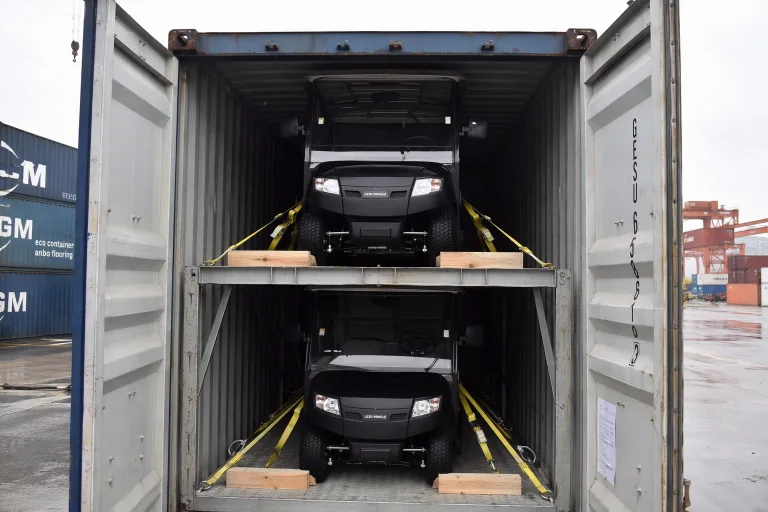
The decision belongs to the customs administration of the importing country. It is not made by a forwarder, by the seller, or by this article. What a supplier can do is state the configuration precisely enough for the question to be put: drive type, seating, the presence or absence of a cargo bed, the design speed, and the intended operating site. Those are the facts the notes operate on. Whether the vehicle also needs a type approval is a separate question, covered in L6e and L7e type approval.
4. What a duty figure is a function of
The Harmonized System carries no rate column, and Article 9 confirms that the Convention assumes no obligation on them: “The Contracting Parties do not assume by this Convention any obligation in relation to rates of Customs duty” [5]. What the code does is select a line: CN subheadings in a declaration “determine: which rate of customs duty applies”, and a line carries “conventional duty rates”, the EU tariff commitments in the WTO plus some autonomous duties [2]. A rate is a commitment recorded against a line, so the figure moves when the commitment moves.
The second input is origin. The baseline obligation is written around it:
… any advantage, favour, privilege or immunity granted by any contracting party to any product originating in or destined for any other country shall be accorded immediately and unconditionally to the like product originating in or destined for the territories of all other contracting parties.
The provision is drafted by reference to where goods originate, and what follows for one consignment is a question for the importing administration. The third input is the version of the schedule: the Commission records that “Every year, Annex I to Council Regulation (EEC) No 2658/87 is updated and published as a stand-alone Regulation in the EU’s Official Journal” [2], so the version in force on the declaration date is the only one that can be quoted.
| Input | Who settles it | Does the code carry it |
|---|---|---|
| The full national code for the destination | The customs administration of that country | Yes, at the length that country uses |
| The origin of the goods | The facts of production, as the importing administration assesses them | No |
| The treatment that applies to that origin | The importing administration | No |
| The version of the schedule in force on the declaration date | The publisher of the tariff, on its own cycle | No |
Three of the four inputs are not in the code, which is why this article carries no rate figure. A number quoted without origin and schedule version is not a smaller answer; it answers a question nobody asked.
5. Where declarations go wrong, and how to get an answer
Three errors account for most of the trouble.
Quoting six digits as if they were the answer. Six digits identify the goods, not the line a declaration is made against [2] [5].
Carrying a code forward from an earlier file. The schedule is republished on a cycle, and the version in force on the declaration date governs [2].
Quoting a rate without its origin. The obligation is drafted around origin, so a rate without one has not been stated.
Put five questions to whoever supplies the number, in writing:
- Is this the full code for the destination, at the length that country uses, or does it stop at six or eight digits?
- Under which origin are the goods being declared?
- Which treatment does that origin attract for this code, and on what basis?
- Which version of the schedule is this, and what is its date?
- Which of those has the supplier confirmed in writing, rather than repeated from a previous file?
Then put the classification question to the destination tariff authority in writing, for that vehicle and configuration. An answer naming an administration rather than a person is the only kind that survives a border, and anything that does not trace back to that authority, or a written reply it issued, is an opinion.
Two narrower points belong in the shipping file. The code follows the goods as packed and declared rather than as marketed, so the invoice configuration has to match the one classified; loading and the packing list are covered in preparing for containerized vehicle shipping. And where the destination also assesses a design standard, classification and the standard are separate tests on the same shipment, as in ADR compliance for LSVs.
Frequently asked questions
Is an HS code the same thing as a tariff code?
No. The HS is a nomenclature of “more than 5,000 commodity groups; each identified by a six digit code” [1]. A tariff code is what a country or customs union builds on that base, and the European Union builds an “8-digit code number” called a CN code on it [2]. The six digits are shared; everything after them belongs to whoever added it.
Can you tell from the length of a code who added its later digits?
No. A position tells you how far a code has been subdivided, not who did it. In the European Union the seventh and eighth digits are CN subheadings and the ninth and tenth are TARIC subheadings, both the Union’s; a Member State adds its own above that [2] [7]. In Japan a ninth digit is already a national statistical code [3].
Can a battery-electric golf car sit under a six-digit line other than the one naming golf cars?
Only if it is not described by that line. 8703.10 covers “golf cars and similar vehicles” and 8703.80 opens with “Other”, so it is residual rather than a parallel option [3]. Whether a vehicle is a golf car or similar is the question, and “similar” is undefined.
Does the country of origin change the duty on the same code?
The baseline obligation is drafted by reference to origin, and requires an advantage granted to a product “originating in” one country to be accorded to the like product “originating in” the others. What that means for a consignment depends on the treatment applying to that origin, and the assessment belongs to the importing administration.
Why does this guide give no rate figure?
Because a rate is a statement about four things at once: the full national code, the origin, the treatment that origin attracts, and the version of the schedule in force on the declaration date [2]. Three of those are not in the code. A figure quoted without them cannot be checked, and an uncheckable figure is worse than none while the goods sit at the border.
Sources
- World Customs Organization. What is the Harmonized System (HS)? Cited 2 November 2026. https://www.wcoomd.org/en/topics/nomenclature/overview/what-is-the-harmonized-system.aspx
- European Commission, Directorate-General for Taxation and Customs Union. Combined Nomenclature. Cited 2 November 2026. https://taxation-customs.ec.europa.eu/customs-4/calculation-customs-duties/customs-tariff/combined-nomenclature_en
- Japan Customs. Japan’s Tariff Schedule (Statistical Code for Import), Chapter 87. 2026. Cited 2 November 2026. https://www.customs.go.jp/english/tariff/2026_10_31/data/e_87.htm
- United Nations Statistics Division. Combined HS commodity reference, HS 2022. Cited 2 November 2026. https://comtradeapi.un.org/files/v1/app/reference/HS.json
- World Customs Organization. International Convention on the Harmonized Commodity Description and Coding System. 1983. Cited 2 November 2026. https://www.wcoomd.org/en/topics/nomenclature/instrument-and-tools/hs_convention.aspx
- World Trade Organization. General Agreement on Tariffs and Trade, Article I, General Most-Favoured-Nation Treatment. 1947. Cited 2 November 2026. https://www.wto.org/english/docs_e/legal_e/gatt47_01_e.htm
- Council of the European Communities. Council Regulation (EEC) No 1969/93 of 19 July 1993 amending Regulation (EEC) No 2658/87, Article 1(a). 1993. Cited 2 November 2026. https://www.legislation.gov.uk/eur/1993/1969