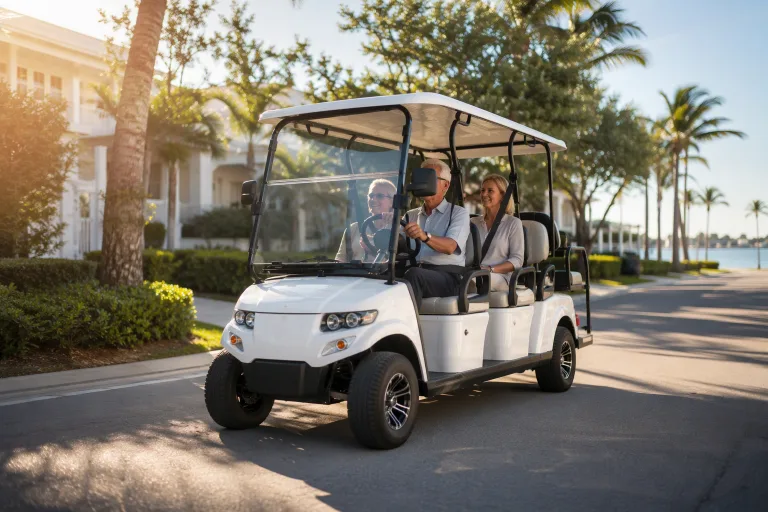

Australian Design Rules, usually shortened to ADR, are written for road vehicles. Whether a golf cart or low speed vehicle needs one in Australia is decided before any standard is tested, by classification under the Road Vehicle Standards Act 2018 [1]. A vehicle only reaches the not-road-vehicle side by meeting a class definition in full, and six conditions have to hold at once for a golf cart. A standard low speed vehicle fitted with lights, mirrors, seatbelts and a plate mount fails one of them and falls on the road vehicle side [1] [2]. Mobile catering vehicles are named in the opposite list and always sit on the road vehicle side [3].
The short version
- ADR compliance follows classification, and classification runs in a fixed order. A vehicle must first meet a class definition in full; only then does section 6(4) of the Road Vehicle Standards Act 2018 remove it from the definition of a road vehicle [1]
- Golf carts are named as vehicles that are not road vehicles. All six conditions in section 5(1) must hold at once, including a maximum of 25 km/h, an unladen mass of 350 kg or less, and none of the six features listed in section 5(2) [2]
- The six features that move a vehicle across the line are direction indicators, brake lights, rear vision mirrors, a registration plate mount, seatbelts, and a fully enclosed cabin with doors [2] [3]
- One of those six items is enough to end golf cart class membership. Any single item removes the vehicle from it [2]
- The design test covers five paragraphs, not one. Section 6(1) reaches vehicles designed principally for public road use, trailers, determined classes, individually determined vehicles, and partly completed or unassembled vehicles [1]
- Mobile catering vans are named as road vehicles. The definition covers a vehicle designed and manufactured for food preparation or vending, and one modified for that purpose [3]
- Importing a road vehicle without an approval is an offence under section 22, and the vehicle is not released from customs control [1] [4]
- A not-road-vehicle import generally cannot be registered for road use in Australia. Registration is a state and territory matter [5]
1. The classification question comes before the standard question
Buyers usually ask whether an LSV needs an ADR. The Act answers a prior question first, and the order matters: a vehicle must satisfy the definition of the class before it can rely on that class. Section 6(1) defines a road vehicle, and section 6(4) then removes from that definition any vehicle that falls within a class the Secretary has determined is not a road vehicle [1]. A vehicle is not a golf cart because it resembles one, and it is a golf cart because it meets all six conditions in section 5(1) [1] [2].
Section 6(1) covers five cases [1]:
| Paragraph | What it covers |
|---|---|
| (a) | A motor vehicle designed solely or principally for use in transport on public roads |
| (b) | A trailer or other vehicle, including wheeled equipment or machinery, designed to be towed on a public road |
| (c) | A vehicle within a class determined under paragraph (5)(a), and not determined under paragraph (6)(b) |
| (d) | A vehicle determined in an instrument under paragraph (6)(a) |
| (e) | A partly completed or unassembled vehicle that would otherwise be covered by any of the above |
Paragraph (e) extends the definition to partly completed and unassembled vehicles, so a kit-form shipment is not automatically outside it. Paragraph (c) is where the Secretary’s determinations do their work, one list naming classes that are road vehicles and one naming classes that are not.
Paragraph (a) is applied on design rather than on paperwork. Section 6(3) states that, for paragraphs (1)(a) and (b), regard is to be had only to the physical and operational features of the motor vehicle when deciding whether it is designed solely or principally for use in transport on public roads [1]. The department’s wording is physical or operational features, and it separately warns that these class definitions hinge on the original manufacturer’s design of the vehicle, not on what you intend to use it for [5]. A brochure listing campuses, estates, farms or industrial sites describes intended use, not physical or operational features [1].
2. The two determinations, and why both exist
The Secretary may determine classes of vehicles that are road vehicles, or classes that are not, by legislative instrument [1]. Two determinations carry out that power, and they work as a pair.
The Road Vehicle Standards (Classes of Vehicles that are not Road Vehicles) Determination 2021, F2021L00956, lists ten classes that are not road vehicles in section 6: agricultural machines, golf carts, light utility vehicles, miniature motorbikes, motorised mobility devices, motorised recreational devices, personal mobility devices, power-assisted pedal cycles, quad bikes, and tracked vehicles [2].
The Road Vehicle Standards (Classes of Vehicles that are Road Vehicles) Determination 2021, F2021L00954, lists six classes that are road vehicles: airport service vehicles, concrete pumpers, dual-purpose motorcycles, food or catering vans, mobile cranes, and vehicles that are campervans or motorhomes [3]. A concrete pumper or a mobile crane can look unusual for road use and still be treated as one, since both definitions require one or more of the features in section 5(2) [3].
The two instruments are revised on separate cycles. F2021L00956 was compiled on 24 December 2025 with amendment F2025L01649 included; F2021L00954 was compiled on 12 October 2023 with amendment F2023L01373 included [2] [3]. The first had its definitions amended in December 2025; the second has not been amended since October 2023.
3. The six conditions that keep a vehicle in the golf cart class
A vehicle has to satisfy every one of the six conditions in section 5(1) of F2021L00956 to be a golf cart [2]:
| Condition | Requirement |
|---|---|
| (a) | Designed to transport people and equipment around a golf course |
| (b) | Designed to travel on at least four high-flotation tyres |
| (c) | Has side-by-side seating |
| (d) | Not capable of exceeding 25 km/h on level ground |
| (e) | Has an unladen mass of no more than 350 kg |
| (f) | None of the six features listed in section 5(2) |
Two of these carry more weight for importers. Condition (a) is a design purpose written into the definition itself. Condition (e) uses a defined term: section 5(1) defines unladen mass as the mass of the vehicle in running order, unoccupied and unladen, with all fluid reservoirs filled to nominal capacity including fuel, and with all standard equipment [2]. No exclusion for traction batteries appears there, so the pack is counted, and a vehicle exceeding 350 kg stops being a golf cart however a brochure describes it.
The same determination defines light utility vehicle with seven conditions: four high-flotation tyres, side-by-side seating, propulsion by electric motors alone or by an internal combustion engine of no more than 1,500 cm3, a steering wheel, a tray back for carrying loads, an unladen mass of no more than 800 kg, and none of the six features in section 5(2) [2]. The higher ceiling still carries that condition.
4. The six features that decide which side of the line a vehicle sits on
Section 5(2) of the not-road-vehicle determination lists six features whose presence moves a vehicle out of that class, and the road vehicle determination defines the same six items [2] [3]:
| Item | Road-going feature |
|---|---|
| (a) | direction indicators |
| (b) | brake lights |
| (c) | rear vision mirrors |
| (d) | provision for mounting a registration plate |
| (e) | seatbelts |
| (f) | a fully enclosed cabin with doors |
Condition (f) of the golf cart definition excludes every vehicle carrying any of those six items [2]. One is enough to fail that condition, and the test does not ask how many were fitted or how small they are.
This is where a standard low speed vehicle specification runs into the definition. Direction indicators, brake lights, rear vision mirrors and seatbelts are fitted to road-capable vehicles for reasons connected to road use, and a plate mount is added so a registration plate can be carried. A vehicle specified with all four, plus the plate mount, has met condition (f) and is no longer a golf cart. Fitting equipment that improves the vehicle moves it out of the less demanding class, not into it. Once a vehicle is outside every class on the not-road-vehicle list, section 6(1)(a) applies and the question becomes whether it is designed solely or principally for use in transport on public roads [1].
5. Mobile catering vehicles sit on the other list
The road vehicle determination names food or catering vans, and section 5(1) of that instrument defines the class [3]:
food or catering van means a motor vehicle that:
(a) is designed and manufactured for the preparation or vending of food; or
(b) has been modified to be used for that purpose.
The example note gives mobile food vans, ice-cream vans and mobile snack trucks as examples [3]. Paragraph (b) reaches a vehicle converted for food service, so a low speed vehicle receiving a kitchen body is caught once the work is done. That places mobile catering vehicles on the road vehicle side of the line, with airport service vehicles, campervans, mobile cranes and concrete pumpers [3]. For these vehicles the ADRs apply, an entry on the Register of Approved Vehicles is required before first provision in Australia, and an import approval is needed before shipment, covered in the mobile catering vehicle guide.
The classification anchor is still the original design. A vehicle designed and manufactured for food preparation or vending is a road vehicle by class. A bare chassis converted after manufacture falls under paragraph (b) as modified [1] [3].
6. What follows from the classification
Once a vehicle is a road vehicle, the Act attaches three obligations at different points, and clearing one does not satisfy the others.
Import. Section 22(1) provides that a person contravenes the subsection if they import a road vehicle into Australia and are not permitted to import it at the time of importation [1]. Section 22(2) then lists when a person is permitted to import one: the importer holds a type approval that is in force and covers the vehicle, the importer is authorised in writing by the holder of an approval that is in force, or the importer holds an import approval that is in force and specifies the vehicle [1]. Section 22(3) makes a contravention an offence [1]. The department states that such a vehicle is not released from customs control [4].
Market entry. Section 24(1) provides that a person contravenes the subsection if they provide a road vehicle to another person in Australia for the first time in Australia, and the vehicle is not on the RAV [1]. The RAV is established by section 14, and section 14(1) requires the Secretary to ensure it is kept [1]. Section 5(2) extends the meaning of provide to cover a sale, exchange, gift, lease, loan, hire or hire-purchase, and the provision of access to the vehicle [1]. Section 24(5) makes a contravention an offence [1].
Registration. Registration sits with state and territory authorities. The department states that a vehicle imported as a non-road vehicle cannot generally be registered for road use in Australia, and that individual authorities may have specific rules on the use of non-road vehicles [5]. Section 78(4) also provides that a State or Territory law may still prohibit or regulate a road vehicle’s use in transport on a public road in that State or Territory if the vehicle ceases to meet the standards in subsection (3) or its operation becomes defective [1]. The classification therefore has to be right before shipment rather than corrected afterwards [5].
A vehicle that is not a road vehicle must also not be supplied to the market or sold to another person or business for use in transport on public roads within the meaning of the RVSA, and doing so may be an offence [5]. The import and sales decisions are assessed separately, and the classification driving the first also drives the second.
7. A working order for an importer
The sequence below puts the classification decision ahead of any standard comparison, which is the order the legislation requires.
- Check whether a class definition is actually met. For a golf cart that means all six conditions in section 5(1) of F2021L00956, including unladen mass of no more than 350 kg and none of the six features in section 5(2). A vehicle that resembles a class but fails one condition does not belong to it [2].
- Only then apply the section 6(4) removal. A vehicle within a determined not-road-vehicle class, and not separately determined to be a road vehicle, is not a road vehicle [1].
- If no class definition is met, test the design. Assess physical and operational features against section 6(1)(a) only, as section 6(3) directs [1].
- Check whether the vehicle is named in the road vehicle list [3].
- Decide the import route before booking shipping. Road vehicles need an approval through the department’s ROVER portal; a not-road-vehicle import does not, though an applicant can still seek an advisory notice that a thing is not a road vehicle, issued under section 233 of the Road Vehicle Standards Rules 2019 [5].
- For a road vehicle, arrange the RAV entry before first supply in Australia, as section 24(1) attaches the obligation to that point [1].
- Treat state registration as a separate question. It is not answered by the federal approval [5].
For a buyer who already holds European type approval, the point is that the two systems do not connect. Australian Design Rules are not part of the European approval chain and no Australian approval follows from a European one. The European classification is set out in L6e and L7e type approval, and the position on registration elsewhere in Europe is covered in LSV registration in Europe.
8. Frequently asked questions
Do Australian Design Rules apply to all golf carts and LSVs?
No. Australian Design Rules are written for road vehicles. Whether one applies to a particular vehicle is settled by classification first. A vehicle inside a class listed as not a road vehicle under section 6 of the Road Vehicle Standards (Classes of Vehicles that are not Road Vehicles) Determination 2021 does not need an ADR, while a vehicle outside every listed class is assessed on whether it is designed solely or principally for use in transport on public roads.
What are the six features that end golf cart class membership, and does fitting them help?
Section 5(2) of both determinations lists the same six items: direction indicators, brake lights, rear vision mirrors, provision for mounting a registration plate, seatbelts, and a fully enclosed cabin with doors. They do not help. Condition (f) of the golf cart definition excludes any vehicle carrying one of them, so a single item is enough to end that class membership. The department states that these definitions hinge on the original manufacturer’s design of the vehicle rather than on what you intend to use it for.
Are mobile catering vehicles treated differently from golf carts?
Yes, and the treatment runs the opposite way. Section 6 of the Road Vehicle Standards (Classes of Vehicles that are Road Vehicles) Determination 2021 names food or catering vans as a class of road vehicle. The definition in section 5(1) covers a motor vehicle designed and manufactured for the preparation or vending of food, and one modified to be used for that purpose, with mobile food vans, ice-cream vans and mobile snack trucks given as examples. Paragraph (b) reaches a converted chassis, so fitting a kitchen body is enough. These vehicles require ADRs, an entry on the Register of Approved Vehicles, and an import approval.
Is importing a road vehicle without an approval an offence?
Yes. Section 22(1) of the Road Vehicle Standards Act 2018 provides that a person contravenes the subsection if they import a road vehicle into Australia and are not permitted to import it at the time of importation. Section 22(3) makes a contravention an offence, and section 22(2) lists when a person is permitted to import one: the importer holds a type approval that is in force and covers the vehicle, the importer is authorised in writing by the holder of an approval that is in force, or the importer holds an import approval that is in force and specifies the vehicle. A vehicle arriving without an approval is not released from customs control, and storage costs fall on the importer.
Can I import a vehicle as not a road vehicle and register it for road use later?
Generally no. The department states that any vehicle imported as a non-road vehicle cannot generally be registered for road use in Australia, and that state and territory authorities may have their own rules on the use of non-road vehicles. That is why the classification has to be settled before shipment rather than corrected afterwards, and it is not settled by a federal approval in any event.
Does European type approval help with Australian requirements?
No. Australian Design Rules sit outside the European approval chain, and no Australian approval follows from a European one. In the European system, category L vehicles are type approved under Regulation (EU) No 168/2013. In Australia, the starting point is classification under the Road Vehicle Standards Act 2018, and where a vehicle lands is decided by the two determinations before any design rule is tested.
What is the Register of Approved Vehicles and when does it come in?
The Register of Approved Vehicles is established by section 14 of the Road Vehicle Standards Act 2018 and is kept by the Secretary. Section 24(1) provides that a person contravenes the subsection if they provide a road vehicle to another person in Australia for the first time in Australia and the vehicle is not on the RAV, and section 24(5) makes a contravention an offence. The obligation attaches to first provision in Australia, a step separate from clearing customs.
9. Sources
- Australian Government. Road Vehicle Standards Act 2018, No. 163, 2018. Current compilation C2025C00016, Compilation No. 3, compilation date 1 January 2025. Includes amendments: Act No. 35, 2024. Sections 5, 6, 14, 22 and 24. Cited 21 October 2026. https://www.legislation.gov.au/C2018A00163/latest/text
- Australian Government. Road Vehicle Standards (Classes of Vehicles that are not Road Vehicles) Determination 2021, made 1 July 2021. Current compilation F2026C00054, Compilation No. 1, compilation date 24 December 2025. Includes amendments: F2025L01649. Sections 5 and 6. Cited 21 October 2026. https://www.legislation.gov.au/F2021L00956/latest/text
- Australian Government. Road Vehicle Standards (Classes of Vehicles that are Road Vehicles) Determination 2021, made 1 July 2021. Current compilation F2023C00915, Compilation No. 1, compilation date 12 October 2023. Includes amendments up to: F2023L01373. Sections 5 and 6. Cited 21 October 2026. https://www.legislation.gov.au/F2021L00954/latest/text
- Department of Infrastructure, Transport, Regional Development, Communications, Sport and the Arts. Importing a road vehicle into Australia. Cited 19 October 2026. https://www.infrastructure.gov.au/infrastructure-transport-vehicles/vehicles/importing-road-vehicle-australia
- Department of Infrastructure, Transport, Regional Development, Communications, Sport and the Arts. Advisory notice that a thing is not a road vehicle. Cited 19 October 2026. https://www.infrastructure.gov.au/infrastructure-transport-vehicles/vehicles/importing-vehicle/advisory-notice-narv