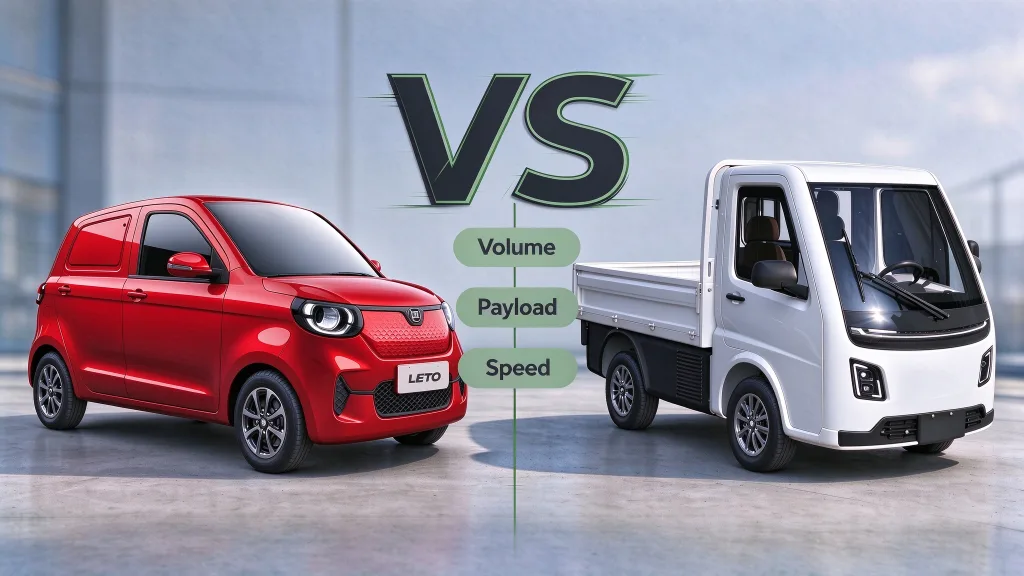
An electric cargo van and an electric mini truck can look interchangeable in a procurement spreadsheet, but they constrain a delivery route in different ways. A closed box van is limited first by internal volume and its stated light-cargo payload; a cab-and-chassis mini truck is limited first by rated payload and by which cargo body is fitted. Choosing between them means checking volume, mass, site geometry, and duty cycle separately, then confirming the applicable rules in the destination country. Every figure below is a manufacturer-stated specification from the product page, as stated on the product pages listed in Sources. These are not independently tested or certified figures, and no road-access, registration, or legal speed conclusion follows from them.
The short version
- Describe the load first: outer carton dimensions, unit mass, units per trip, stacking, weather protection, and loading method. Volume and mass are independent constraints.
- A closed cargo box and interchangeable bodies solve different problems. Ask each body’s mass and changeover time before assuming one chassis covers several jobs.
- The stated 70 km/h, 65 km/h, and 80 km/h figures are version-dependent design speed figures, not legal speed limits or road permissions. Confirm the applicable requirements in the destination country.
- Turning figures on the two pages are not expressed in the same way. One is a turning diameter and the other a turning radius, so the printed numbers cannot be compared directly.
- The Cargo 265 km figure is NEDC-rated laboratory range; the Hauler page states no test cycle for its range figures. Charging times depend on site supply the product pages do not fully specify.
- The published USD 550 comparison is a manufacturer’s directional comparison estimate, not a measured operating cost; the page gives example unit prices, not local prices.
1. Start with the load, not the model names
Comparing two headline numbers is the wrong starting point. Record what the vehicle carries on a normal day: outer carton dimensions, unit mass, units per trip, stacking, weather protection, and loading method. Then record the route: trip length, number of stops, time spent stationary, gradients, and the width of the tightest access point. Light, bulky goods tend to fill a closed box before the mass limit matters; dense goods can reach the mass limit while the box still looks empty. A broader last-mile delivery vehicle comparison frames vehicle classes, not a two-model shortlist.
2. Volume: what 1,375 liters actually constrains
Start from the load space rather than the headline number. The listed cargo box holds 1,375 liters and a maximum light-cargo payload of 350 kg, with interior load dimensions of 1250 mm long by 1100 mm wide and 1000 mm high, in a 2920 mm footprint, and a partition between the cab and the cargo box [1]. Internal volume is a geometric quantity, not a count of parcels. Check the outer packaging against that envelope: an item taller than 1000 mm will not fit, and common pallet footprints may not tile into 1100 mm of width. Request a dimensioned drawing of the clear load space with the partition, wheel arches, door opening, and any shelving or dividers included. The volume figure alone does not give the clear door aperture, the usable height after a divider is fitted, or how much space a refrigeration unit would take.
3. Payload: 350 kg and 650 kg answer different questions
Payload wording is where the two listings diverge. The 650 kg figure is the stated payload of a cab-and-chassis truck offered with nine interchangeable cargo bodies [2]; the 350 kg figure is the maximum light-cargo payload of the closed van [1]. Reading one as smaller skips what is included in each stated payload. The two figures use different product-page wording. A closed van carries its box as part of the vehicle; a cab-and-chassis truck carries a separate body whose own mass must be accounted for. Ask for the rated gross vehicle mass, curb mass, the mass of each cargo body option, permitted axle loads, load distribution limits, and whether the driver, passengers, tools, and fitted equipment are included. The Cargo page separately gives a 680 kg curb weight [1], which is the mass of the vehicle itself, not an additional carrying allowance. A configuration-specific sheet beats a single number in a comparison table, and a utility cart payload guide can separate rated capacity from what a site will carry. Which limit binds first depends on goods density; a buyer with only one of unit mass or unit volume cannot calculate it.
4. Design speed is a specification, not a road permission
Design speed is not one number but a set of version figures. A 70 km/h class figure appears for the closed van [1], while the cab-and-chassis truck splits into a low-speed 65 km/h version and a high-speed 80 km/h version, each with its own battery pack and range figure [2]. These are version-dependent design speed figures for different model versions. Design speed is not a legal speed limit and does not establish registration, licensing, insurance, or access to any road class. The product pages are commercial descriptions, not regulatory determinations. Confirm any road-access question against destination-country rules with the relevant authority and the supplier’s documentation for the exact configuration before choosing a version. Quote the 65 km/h and 80 km/h versions as separate line items, each with its own pack, range, charging time, and documentation. Do not assume a lower design speed simplifies approval in a given market, or that a higher one is needed for every route; both turn a specification into a legal claim. The electric delivery vehicle for last mile material covers route and operating considerations separately from any approval question.
5. One closed box or nine interchangeable bodies
Body form is a clear structural difference. One vehicle carries a single closed, insulated box [1]; the other is built around a cab and chassis and lists nine interchangeable bodies, including open flatbeds, tippers, box trucks, and flatbeds with low rails [2]. A single closed box suits loads needing enclosure, insulation, and a fixed layout; a chassis with several bodies can cover different tasks only if changeover is practical. Request the part number and mass of each body, the time and equipment needed to change one, where spare bodies are stored, whether a body change affects the rated payload, and whether the warranty covers the coupling hardware. One truck replacing two is a conditional outcome, not a conclusion: it depends on the payload and box configuration, how often the work changes, and the cost of extra bodies. A flatbed vs box cargo vehicle comparison is useful when the decision is about body form rather than vehicle class. Ask too how partitions, tie-down points, shelving, and temperature control are specified for each body, since these change the usable internal dimensions.
6. Turning figures: do not compare 8.3 m with 3690 mm directly
Two turning numbers that look comparable are not. One is an 8.3 meter turning diameter, called the shortest turning circle in the range [1]; the other is a 3690 mm turning radius [2]. Because one is a diameter and the other a radius, comparing 8.3 m with 3690 mm as the same measurement produces a false conclusion. Before using either number, ask the supplier for the measurement definition: turning circle, radius, or diameter; wall-to-wall or center-of-vehicle path; whether mirrors and body overhang are included; and unladen or fully laden condition. Then measure the site: narrowest lane, internal turning area at loading points, gate widths, ramp gradients, and floor loading limits. The Cargo page also gives 200 mm of ground clearance and a 20 percent climbable gradient [1]; neither replaces a site survey. The phrase “shortest in the range” is a comparison within the manufacturer’s own range, as stated on the product page.
7. Range and charging are version-dependent
Pack size and range move together with the version. A 72 V, 15 kWh lithium iron phosphate pack carries a 265 km NEDC-rated range [1]; the truck comes in a low-speed version with a 20.6 kWh pack for 240 to 270 km, recharging in 4 to 6.5 hours, and a high-speed version with a 27.2 kWh pack for 200 to 250 km, taking 6.5 to 10 hours to charge [2]. Only the Cargo figure is labeled NEDC on its product page; the Hauler page states no test cycle for either range figure, so those are manufacturer-stated range figures with the test conditions unstated. An NEDC-rated range is a laboratory test cycle result, not real-world range. A laboratory cycle does not reproduce a loaded route with stops, gradients, climate control, or cold weather. Neither product page gives a real-world range figure for these two models, so none should be supplied by inference or borrowed from another model. Ask for consumption data under a comparable duty cycle and record the test conditions with the figure. Charging times depend on site supply, the charger, starting state of charge, and ambient temperature; ask for charger output, connector type, required supply, and whether the time is to full charge or a stated state of charge [2].
8. Reading the published cost comparison
A published energy and maintenance comparison sits on the truck’s product page: roughly USD 550 against USD 2,832 to 3,776 for a diesel micro-van, covering 30,000 km a year [2]. This is a manufacturer’s directional comparison estimate, not a measured operating cost. The page does give an example calculation: electricity at USD 0.15 per kWh with 3,000 kWh a year plus around USD 100 of maintenance gives roughly USD 550; the diesel micro-van uses 1,800 to 2,400 liters at USD 1.0 per liter with USD 600 to 800 of maintenance [2]. It calls the figures “directional rather than universal, because electricity and diesel prices differ by market and the duty cycle changes consumption” [2]. It does not state a geographic basis, tax or insurance treatment, the maintenance items included, or a reference year, so the example unit prices are not the buyer’s local prices. The comparison is against a stated diesel vehicle, not against the Cargo. Do not present USD 550 as the running cost, subtract it from a budget line, or extend it into a payback period. Use it to build a local worksheet with the buyer’s own tariff, annual distance, service quote, insurance, and purchase and setup costs. A structured electric cargo vehicle operating costs breakdown can supply cost categories, but inputs need local quotes.
9. What to put in the RFQ
Ask both suppliers for a written quotation that names the exact version and configuration. For the closed box van, request a dimensioned drawing of the clear load space with the partition and door aperture, the volume and payload figures with their definitions, the curb mass, the rated gross mass, and the ground clearance. For the cab-and-chassis truck, request the same mass data plus the available cargo bodies with part numbers, individual masses, load ratings, changeover time, and equipment needed. For both, request the pack capacity, the range figures with their test conditions (the Hauler page states no test cycle), any consumption data for a comparable duty cycle, the charger specification, the stated charging time and its starting state of charge, and the warranty terms for the battery, drive unit, and body hardware. Ask which figures are manufacturer-stated and which, if any, come from independent testing, and verify the supplier’s documentation with the relevant authority before ordering. Record the site constraints and weekly duty cycle in the same document as the quotes. A fleet sizing exercise such as sizing an electric delivery vehicle can help set the number of vehicles, but the choice between these two models follows the load, the route, and the site. No single parameter, taken alone, decides it.
Frequently asked questions
Is 1,375 liters or 350 kg the limit that matters first?
Neither one takes priority in general. They are independent constraints stated on the Cargo product page [1]. Light, bulky goods can fill 1,375 liters before reaching 350 kg, while dense goods can reach the mass limit with space left over. Record both unit volume and unit mass for the actual load, then check each against the stated figure.
Does the 650 kg mini truck necessarily carry more than the cargo van?
Not as a general conclusion. The 650 kg figure is the Hauler’s stated payload and the 350 kg figure is the Cargo’s stated maximum light-cargo payload, and the product pages do not establish that they use the same basis [1][2]. Ask for rated gross mass, curb mass, the mass of each cargo body, and load distribution limits before comparing.
Are 70 km/h, 65 km/h, and 80 km/h legal speed limits?
No. They are version-dependent design speed figures stated on the two product pages [1][2]. They do not establish a legal speed limit, registration, insurance, or access to any class of road. Confirm the applicable requirements against destination-country rules with the relevant authority and the supplier’s documentation.
Can I compare the 8.3 m and 3690 mm turning figures directly?
No. The Cargo page states an 8.3 meter turning diameter, while the Hauler page states a 3690 mm turning radius [1][2]. One is a diameter and the other a radius, expressed in different units. Ask each supplier for the measurement definition and survey the site before drawing a conclusion about maneuverability.
Is USD 550 per year the actual running cost?
No. As stated on the Hauler product page, it is a published comparison of energy and maintenance against a diesel micro-van covering 30,000 km a year [2]. It is a manufacturer’s directional comparison estimate, not a measured operating cost, and the page gives example unit prices rather than the buyer’s local prices, with no geographic basis or reference year.
Sources
- Leto Vehicles. Cargo L7E-CU Electric Van. n.d. Cited 13 November 2026. https://www.letovehicle.com/vehicles/leto-cargo-electric-van/. Notes: Manufacturer-stated specifications from the product page, including internal volume, load dimensions, maximum light-cargo payload, pack capacity, NEDC-rated range, design speed, turning diameter, curb weight, ground clearance, and climbable gradient. Not independently tested or certified figures; no road-access or registration conclusion follows from them.
- Leto Vehicles. Hauler Pure Electric Transport Mini Truck. n.d. Cited 13 November 2026. https://www.letovehicle.com/vehicles/leto-hauler-electric-mini-truck/. Notes: Manufacturer-stated specifications from the product page, including payload, nine interchangeable cargo bodies, two version-dependent design speeds with their pack sizes and range figures (no test cycle stated on the page), charging times, turning radius, and a directional energy and maintenance comparison with example unit prices. The geographic basis, tax and insurance treatment, maintenance items, and reference year are not stated.