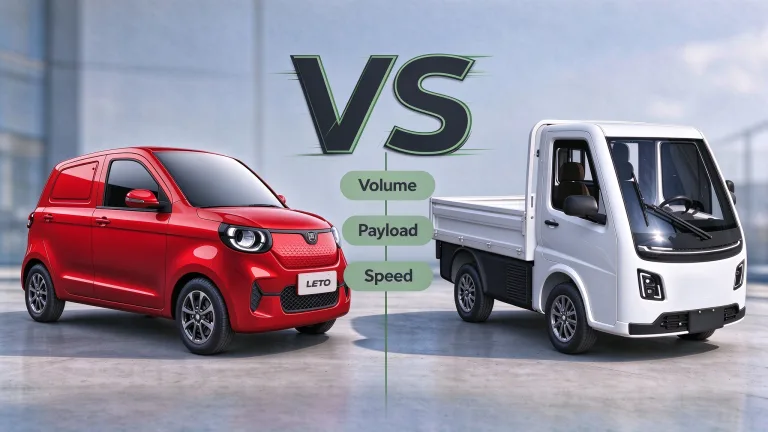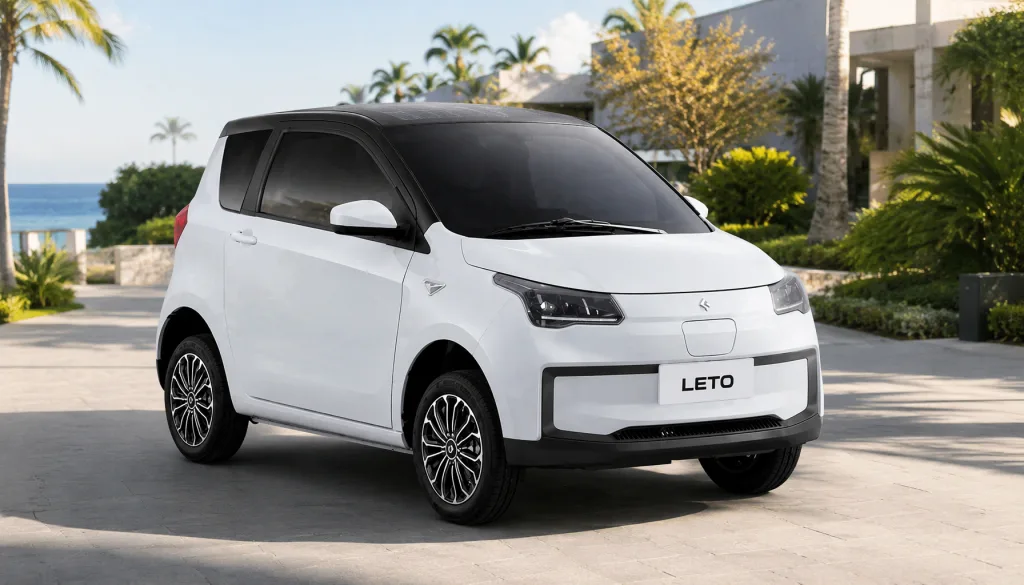
A solar electric car daily range figure is the driving energy a roof photovoltaic system is stated to add in one day, not the distance the vehicle can travel on a single charge. The three models discussed here are the Solar Hatch Electric Car, the Solar Quad L7e Electric Vehicle, and the Solar Taxi Electric Vehicle with Battery Swap. On these product pages that figure is about 30 km on a day with adequate sunlight or good light, as stated on the product page. For resort, campus, and small-fleet buyers at sites without fixed charging points, this article is a method to test that number against a real duty cycle. All vehicle figures below are manufacturer-stated specifications from the three product pages linked above, not third-party measurements, independent verification, or industry-wide values.
The short version
- Separate the roughly 30 km a day added by the roof system from the range on one full pack: replenishment versus single-charge available range.
- Read 200 km and 300 km as NEDC-rated laboratory range, beside the real-world ranges the product pages also give.
- Treat 30 km a day as a manufacturer-stated figure under adequate sunlight or good light, as stated on the product page, with no third-party measurement, not a guarantee, annual average, or regional typical value.
- Estimate fit from daily distance, usable battery energy, sunlight, and parking duration, as a framework rather than a fixed number of avoided charges.
- Match replenishment to the model, since home-socket charging, 220 V charging, and battery swap are different arrangements, as stated on the product page. A solar vehicle solution overview may frame the technology, but the numbers need buyer-side verification.
1. Separate daily energy added from single-charge range
The common error is to read 30 km a day as one trip. It is an energy contribution from the roof system over a day with adequate sunlight, as stated on the product page, not the distance the vehicle covers before it needs energy again. That second number appears as NEDC-rated laboratory range and, separately, as real-world driving range.
The Solar Hatch and Solar Taxi pages each state an NEDC-rated laboratory range of 200 km, while the Solar Quad states 300 km with an E-LOOP configuration rated at over 400 km, all as manufacturer-stated specifications from the product page. Read these laboratory or configuration figures beside the real-world ranges in the table in Section 4, and keep daily added energy in a separate column. A full pack still covers a long distance on an overcast day.
2. Where the 30 km figure comes from
All three product pages put the daily solar contribution at roughly 30 km, but the wording and conditions differ by model. The Solar Hatch frames it for a vehicle doing 30 to 50 km a day and says the roof photovoltaic system typically adds a further 30 km on a day with adequate sunlight, stating that the solar contribution alone covers most of the driving. The Solar Quad puts it at about 30 km on a day with good light, and the Solar Taxi at about 30 km of range per day, typically added on a day of adequate sunlight.
Each is a manufacturer-stated specification from the product page, not a third-party measurement, independent verification, or industry-wide value; “covers most of the driving” is a product-page characterization, not a conclusion here. The condition is adequate sunlight or good light, with no third-party measurement, seasonal average, or regional typical value supplied, so it is not a guarantee, annual average, or typical value for any location. Consumption is around 5 kWh per 100 km on all three pages, as stated on the product page.
3. Put the duty cycle beside the numbers
Judge the stated daily contribution against a specific operating pattern using inputs the buyer can record. Log average daily distance over a representative period, including quiet and busy days, since an average hides the spread. Record usable battery energy for the exact configuration, as stated on the product page, and consumption with its test conditions. Note sunlight and parking duration: hours in the open, whether under cover, and how that changes by season.
With those inputs the buyer can ask a bounded question: on a given day, how does the energy drawn by the day’s distance compare with the energy the roof system is stated to add and the usable energy in the pack at the start of the day? That is a framework for the supplier discussion, not a calculation this article resolves into avoided charges. Any claim about how often the vehicle is plugged in needs a measured operating record, so keep it out of the plan. A fleet charging infrastructure review can frame site questions but does not supply the solar figure.
4. Compare the three models without merging their ranges
The product pages give laboratory and real-world figures that differ by model. Keep them separate.
| Model | Stated pack and motor | Laboratory range | Real-world range | Daily solar figure |
|---|---|---|---|---|
| Solar Hatch | 9.8 kWh lithium iron phosphate, 25 kW permanent magnet synchronous motor, 96 V | NEDC-rated laboratory range of 200 km | Real driving in mixed conditions typically delivers 90 to 160 km | Typically adds a further 30 km on a day with adequate sunlight |
| Solar Quad | 23.66 kWh NCM622, 96 V | NEDC-rated laboratory range of 300 km; E-LOOP configuration rated at over 400 km | Real-world driving typically lands at 150 to 250 km depending on speed, load and weather | Adds about 30 km on a day with good light |
| Solar Taxi | Swappable 9.8 kWh lithium iron phosphate, 25 kW motor, 90 km/h | NEDC-rated laboratory range of 200 km | Real-world driving usually lands at 100 to 160 km depending on speed, load and traffic | About 30 km of range per day |
All entries are manufacturer-stated specifications from the product page. The three real-world intervals are distinct: the Solar Hatch is stated as 90 to 160 km, the Solar Quad as 150 to 250 km, and the Solar Taxi as 100 to 160 km; they should not be merged. The E-LOOP figure is a configuration rating, not an NEDC laboratory range or a real-world measurement.
The Solar Quad page describes the vehicle as an L7e class heavy-duty electric quadricycle and lists EEC whole vehicle type approval under certificate e13168/201302250*00, as stated on the product page. This is product-page classification wording, as stated on the product page, in the L7e-CU category rather than L6e. This article draws no registration, road-use, or approval conclusion from it.
5. Match the replenishment method to the model
The three vehicles do not return energy the same way, so one model’s conclusion cannot be applied to another.
Replenishment is not one method across the range. The Solar Hatch refills on a domestic socket in four to five hours through the on-board charger; the Solar Quad uses a 220 V supply and about eight hours from 20 percent state of charge; the Solar Taxi uses a swappable 9.8 kWh lithium iron phosphate pack, with a swap of about fifty seconds. Each figure is a manufacturer-stated specification from the product page.
For a charging model, ask about the supply at the parking location, the on-board charger, and stationary hours. For a swap model, ask about the swap arrangement, the number of packs, and where swapping happens. Do not carry a fifty-second swap conclusion to a vehicle that refills over four to five hours. A battery swap versus charging comparison can structure those questions, but the figures come from the product page.
6. List the variables, then verify them
A figure stated under adequate sunlight will not hold under every condition. List the variables and decide what to verify; the product pages give no adjustment factors, and this article supplies none.
Light and season change available solar energy day to day and across the year. Parking position matters: an open roof and a shaded or covered space are not equivalent. Anything shading the roof, including roof-mounted accessories, reduces exposed area. Driving conditions also change the energy a day’s distance requires, including load, speed, traffic, gradients, and air conditioning or heating. The Solar Taxi page ties its real-world interval to speed, load and traffic, as stated on the product page. For each variable, ask what was held constant in the 30 km statement and what changes outside those conditions. Record the answers as conditions to test on site, not as a discount coefficient.
7. Keep V2L separate from range
V2L, or vehicle-to-load, is a power outlet function. It supplies 220 V to external equipment; it does not add driving range and is not part of the solar contribution. The Solar Quad and Solar Taxi pages state a 220 V output at 3 to 6 kW, as stated on the product page. The Solar Hatch page states a 220 V supply, as stated on the product page, and this article does not cite a kW figure for that model, so none is assumed.
Because V2L draws energy out of the pack, keep it on the consumption side of the worksheet, not the replenishment side. Equipment powered from the vehicle draws stored energy the roof system may or may not offset, and the product pages do not quantify that interaction. Do not combine V2L with the 30 km figure into a combined range or savings claim.
8. What to request before choosing
A defensible purchase decision rests on written answers collected before placing an order, not a rounded headline number. Ask each supplier for the following.
- The test conditions and definition behind the 30 km a day figure, including sunlight, parking setup, and whether it is a stated daily contribution rather than a measured or guaranteed value.
- The conditions behind both the NEDC-rated laboratory range and any real-world range figure, and which applies to the intended operating profile.
- The usable battery capacity and chemistry for the exact configuration, and consumption with its test conditions.
- The charging or swap equipment list, the supply required at the site, and whether installation or site electrical work is included. When comparing configurations, buyers can also review electric vehicle maintenance schedules and battery assessment guidance; neither is a lifespan or charging-free promise.
- The V2L output specification for the exact model and conditions on its use.
- The written warranty scope, including coverage, exclusions, and how the roof photovoltaic system and pack are treated.
Place those answers beside the buyer’s logged daily distance, sunlight, and parking duration. Neither a laboratory range figure nor a daily solar contribution is a complete answer about fit.
Frequently asked questions
Does the 30 km a day figure mean the car can drive 30 km on solar power alone?
No. It is a manufacturer-stated daily energy contribution under adequate sunlight, as stated on the product page, not single-charge range. Daily energy added and single-charge available range are different numbers. Ask the supplier for the test conditions behind it.
Is 30 km a day a guaranteed or measured annual average?
No. The product pages describe about 30 km on a day with adequate sunlight or good light, as stated on the product page, with no third-party measurement provided. It is not a guarantee, an annual average, or a typical value for any region. Verify the conditions with the supplier.
Do I still need charging equipment if the vehicle has a roof solar system?
That is a question for the supplier. The product pages specify charging or swap arrangements for each model, as stated on the product page. Ask what equipment is included, what site supply is required, and how the solar contribution is accounted for. No conclusion about avoiding charging equipment is given here.
Can I apply the Solar Taxi swap time to the charging models?
No. The three models use different replenishment methods, as stated on the product page. The Solar Hatch refills on a domestic socket in four to five hours, the Solar Quad on a 220 V supply in about eight hours from 20 percent state of charge, and the Solar Taxi by a battery swap of about fifty seconds. Do not carry a swap-based conclusion to a charging model.
What should I verify before using the 30 km figure in a purchase plan?
Ask the supplier for the test conditions and definition behind the 30 km figure, the conditions behind the NEDC and real-world range figures, the usable battery capacity, the charging or swap equipment list and site electrical conditions, the V2L output specification, and the written warranty scope. Then compare those answers with the buyer’s own daily distance, parking time, and sunlight conditions.
Notes
All vehicle figures in this article are manufacturer-stated specifications from the three product pages linked above. They are not third-party measurements, independent verification, or industry-wide values, and no registration, road-use, or approval conclusion follows from them.
The roughly 30 km a day figure is a manufacturer-stated daily energy contribution under adequate sunlight or good light, as stated on the respective product pages. No third-party measurement, seasonal average, or regional typical value is supplied, so it is not a guarantee, an annual average, or a typical value for any location.
The 200 km, 300 km, and over 400 km figures are NEDC-rated laboratory range or configuration ratings stated on the product pages; the E-LOOP figure is a configuration rating, not an NEDC laboratory range or a real-world measurement. The real-world intervals, 90 to 160 km, 150 to 250 km, and 100 to 160 km, are distinct manufacturer-stated ranges and are not merged here.
Replenishment figures (four to five hours on a domestic socket, about eight hours from 20 percent state of charge on a 220 V supply, and a swap of about fifty seconds) and the 220 V V2L output are manufacturer-stated specifications from the product pages. Consumption of around 5 kWh per 100 km is likewise stated on all three product pages.