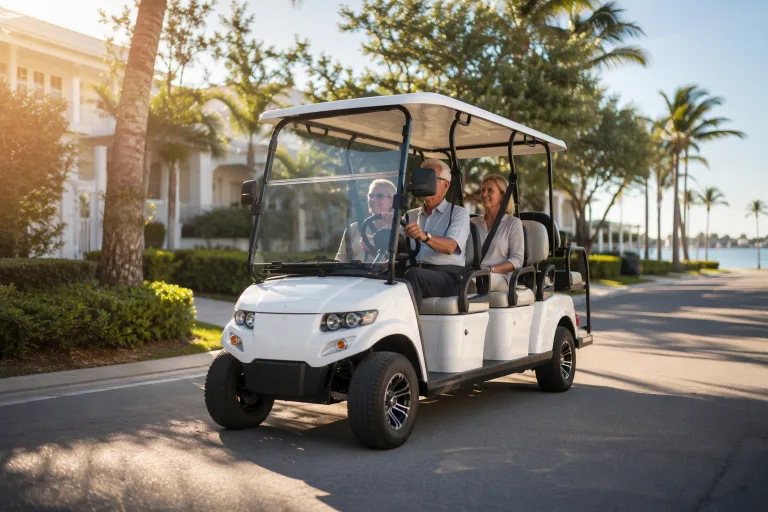
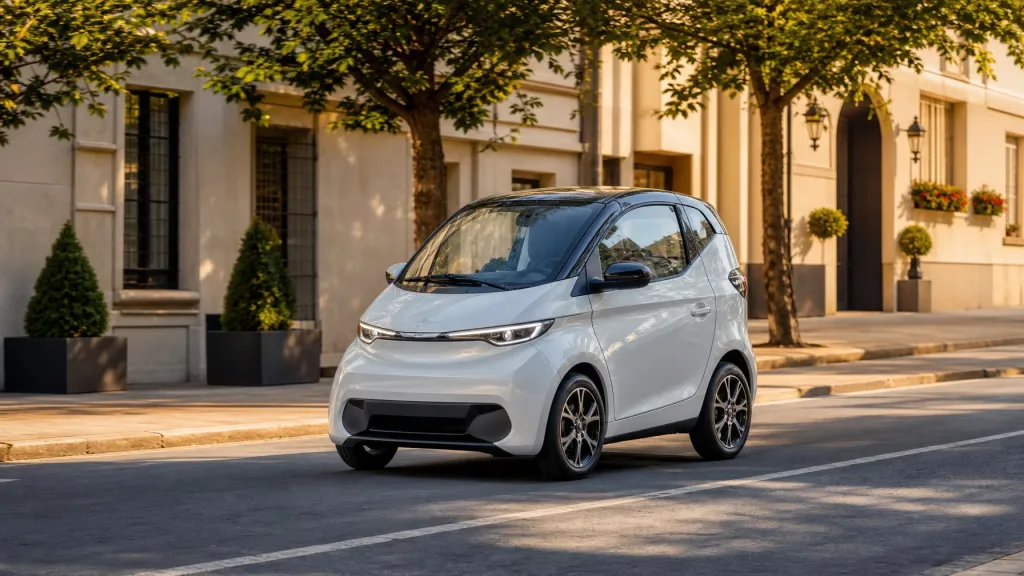
L6e and L7e are the two European quadricycle classes covering road-capable electric golf carts and low speed vehicles, separated by mass in running order, power, seating and dimensions. L6e is the light quadricycle, capped at 425 kg mass in running order with at most two seating positions. L7e is the heavy quadricycle, limited to 450 kg for passengers and 600 kg for goods. Both sit under Regulation (EU) No 168/2013 [1].
In the EU a vehicle type must be examined by an appointed technical service and approved by an approving authority before units are placed on the market [1]. A manufacturer cannot rely on its own declaration.
The short version
- L6e and L7e are quadricycle classes defined in Article 4(2) and detailed in Annex I of Regulation (EU) No 168/2013 [1]
- L6e is the light quadricycle: mass in running order not exceeding 425 kg, at most two seating positions including the driver, maximum design speed not exceeding 45 km/h
- L7e is the heavy quadricycle: mass in running order not exceeding 450 kg for passengers and 600 kg for goods. Speed is set per sub-class, and only L7e-B1, L7e-C, L7e-CU, and L7e-CP carry a 90 km/h ceiling
- Article 25(1) gives four type-approval procedures: step-by-step, single-step, mixed, and multi-stage. Multi-stage is available only to L2e-U, L4e, L5e-B, L6e-BU, and L7e-CU [1]
- T he applicant is the manufacturer, and a manufacturer outside the EU must appoint a single representative inside it under Article 9(4) [1]
- Individual vehicle approval is national. Article 1(1) states this Regulation does not apply to it [1]
- Mass in running order excludes the propulsion batteries for hybrid and pure electric vehicles under Article 5(2)(c), so a bigger battery does not by itself raise the bracket [1]
- Approval does not equal registration. Article 1(3) leaves road-safety legislation untouched, so road use depends on rules that vary between Member States [1]
1. Category L runs on its own approval track
Regulation (EU) No 168/2013 covers type approval for categories L, R, and S. Category L takes in the quadricycle family, mopeds, and the L5e powered tricycles. Categories M and N run on a separate track, Directive 2007/46/EC, referenced in Article 2(2)(f) and replaced from 1 September 2020 by Regulation (EU) 2018/858 [2]; neither act reaches category L. Regulation 168/2013 repealed Directive 2002/24/EC per Recitals 27 and 28 and Article 81 [1]. Directive 2006/126/EC sits on neither track, being the third driving license directive [3].
For a buyer, a golf cart cannot reach market access through the route used for cars and trucks, and neither route reaches the other. An L7e is approved, certified and documented under Regulation 168/2013; nothing in that makes it an M or N vehicle [1] [2].
2. Where L6e and L7e sit among the L categories
Category L runs from mopeds at the bottom through quadricycles to the powered tricycles. L5e is a powered tricycle, not a heavier quadricycle. Article 4(2)(e) defines L5e as a powered tricycle and splits it into L5e-A for tricycles and L5e-B for commercial tricycles [1]. A four wheeled vehicle that gets heavier does not move up into L5e; it moves from L6e to L7e. Article 4(4) decides that: a vehicle failing at least one standard for its category belongs to the next category whose standards it does meet, pairing L2e with L5e and L6e with L7e [1].
The boundary between a standard golf cart and either class is the classification itself, not a trim level or a distributor’s speed limit, as set out in electric golf cart vs LSV. A machine never put through Regulation 168/2013 does not become an L6e or L7e by having a certificate attached later.
3. Sub-classes, and what actually separates them
Annex I defines each class through common criteria plus sub-class specific ones.
| Class or sub-class | Mass in running order | Maximum continuous rated or net power | Maximum design speed | Seating |
|---|---|---|---|---|
| L6e common | Not exceeding 425 kg | Set per sub-class | Not exceeding 45 km/h | A maximum of two seating positions, including the driver |
| L6e-A light on-road quad | As L6e | Not exceeding 4,000 W | As L6e | As L6e |
| L6e-B light quadri-mobile | As L6e | Not exceeding 6,000 W | As L6e | Enclosed cab accessible from up to three sides |
| L6e-BP for passenger transport | As L6e | As L6e-B | As L6e | Mainly designed for passenger transport |
| L6e-BU for utility purposes | As L6e | As L6e-B | As L6e | Goods only, load platform able to take a 600 mm cube |
| L7e common | Not exceeding 450 kg for passengers, 600 kg for goods | Set per sub-class | No speed clause | Set per sub-class |
| L7e-A heavy on-road quad | As L7e | Not exceeding 15 kW | No speed clause | Passenger transport only, not L7e-B or L7e-C |
| L7e-A1 on-road quad | As L7e-A | As L7e-A | No separate speed clause | A maximum of two straddle seating positions, handlebar steering |
| L7e-A2 on-road quad | As L7e-A | As L7e-A | No separate speed clause | A maximum of two non-straddle seats |
| L7e-B1 heavy all terrain quad | As L7e | No power clause in this row | Not exceeding 90 km/h | A maximum of two straddle seating positions, handlebar steering |
| L7e-B2 side-by-side buggy | As L7e | Not exceeding 15 kW | No speed clause | A maximum of three non-straddle seats, two side by side, including the driver |
| L7e-C heavy quadri-mobile | As L7e | Not exceeding 15 kW | Not exceeding 90 km/h | Enclosed cab accessible from up to three sides |
| L7e-CU heavy quadri-mobile for goods | As L7e-C | As L7e-C | As L7e-C | A maximum of two non-straddle seats, including the driver |
| L7e-CP heavy quadri-mobile for passengers | As L7e-C | As L7e-C | As L7e-C | A maximum of four non-straddle seats, including the driver |
Within L7e, the entries carrying a maximum design vehicle speed not exceeding 90 km/h are L7e-B1, L7e-C, L7e-CU, and L7e-CP. The L7e common, L7e-A, L7e-A1, L7e-A2, and L7e-B2 rows carry no speed clause, so those sub-classes are not certified against a 90 km/h ceiling. Choosing by use case is covered in choosing between L6e and L7e.
Annex I sets a minimum ground clearance of 180 mm for L7e-B, and a wheelbase to ground clearance ratio not exceeding 6 for L7e-B1 and 8 for L7e-B2 [1]. Length is 4,000 mm, with 3,000 mm for L6e-B and 3,700 mm for L7e-C; width 2,000 mm, or 1,500 mm for an L6e-B or L7e-C vehicle; height 2,500 mm. These are overall dimensions, not wheelbase or turning circle.
Article 4(4) is the fallback: a vehicle exceeding at least one criterion for a category falls into the next category whose criteria it meets. The listed sequences pair L6e with L7e [1].
4. The four type-approval procedures in Article 25
Article 25(1) lets a manufacturer applying for whole-vehicle type-approval choose one of four procedures: step-by-step, single-step, mixed, or multi-stage. Multi-stage is limited to the categories in Article 25(6) [1]. Article 25(5) is what makes them workable: the technical requirements sit in the acts listed in Annex II [1].
| Procedure | Legal basis | How it works |
|---|---|---|
| Step-by-step | Article 25(2) | Each system, component, or separate technical unit is type-approved first, and the certificates are assembled to obtain whole-vehicle approval |
| Single-step | Article 25(3) | The whole vehicle is approved in one operation |
| Mixed | Article 25(4) | Step-by-step, except that one or more system approvals are completed at the end of whole-vehicle approval without certificates being issued for them |
| Multi-stage | Article 25(6) | Available only to L2e-U, L4e, L5e-B, L6e-BU, and L7e-CU |
Only the single-step procedure applies to systems, components, and separate technical units [1], and Article 25(7) confirms the procedure chosen does not change the substantive requirements the type must meet.
Regulation 168/2013 does not treat a variant approval as an approval type; revisions and extensions sit in Chapter VI. Individual vehicle approval is a Member State procedure: Article 1(1) excludes it and requires Member States granting such approvals to accept a type-approval granted under this Regulation in place of one granted under national provisions [1]. The forward-looking provisions are Article 79 on advanced braking systems and Article 80 on individual vehicle approvals. Earlier EEC practice is covered in EEC vs EU whole vehicle type approval.
5. The applicant, and what mass in running order actually measures
Article 26 requires the application to be submitted by the manufacturer to the approving authority, and only one application may be submitted for a particular type and in only one Member State [1]. A manufacturer outside the EU must appoint a single representative established within the Union under Article 9(4) [1]. The Article 27 information folder must include an information document and the Article 25(1) procedure chosen [1].
Mass in running order is defined by Article 5. Article 5(1) measures the unladen vehicle ready for normal use and includes liquids, standard equipment, fuel in tanks filled to at least 90 percent of capacity, bodywork, cabin, doors, glazing, coupling, spare wheels, and tools. Article 5(2) excludes the driver at 75 kg and passengers at 65 kg, machinery on the load platform, and, for hybrid or pure electric vehicles, the propulsion batteries. A larger battery therefore does not raise the figure setting the L6e or L7e bracket, and the category follows from Article 4(4) [1].
| Concept | Basis | What it controls |
|---|---|---|
| Mass in running order | Article 5, batteries excluded for hybrid and pure electric vehicles | The L6e 425 kg ceiling and the L7e 450 kg and 600 kg ceilings |
| Maximum permissible mass | Not set by Regulation 168/2013; check the applicable delegated regulation and national rules | Maximum mass the vehicle may be approved for, separate from mass in running order |
| Category assignment | Article 4(4) | Which class applies once a standard is not met |
6. Where the technical requirements actually live
Regulation (EU) No 168/2013 runs to nine annexes. Annex I is Categories of L-category vehicles and sub-categories, and Annex II the exhaustive list of requirements, a matrix of items against vehicle categories marked X or IF with no technical values. Annex III sets the small series limits, at 30 units a year for an L6e-A or L7e-A type, 50 for L7e-B, and 150 for L6e-B and L7e-C. Annex IV is the application timetable, Annexes V to VIII cover environmental, durability and enhanced safety requirements, and Annex IX is the correlation table for the repealed Directive 2002/24/EC [1].
| Requirement area | Where it is set |
|---|---|
| Braking, including anti-lock and combined systems | Delegated Reg (EU) No 3/2014, Article 7 |
| Electrical safety | Delegated Reg (EU) No 3/2014, Article 8 |
| Lighting and light-signalling device installation | Delegated Reg (EU) No 3/2014, Article 13 |
| Safety belt anchorages and safety belts | Delegated Reg (EU) No 3/2014, Article 16 |
| Seating positions | Delegated Reg (EU) No 3/2014, Article 17 |
| Occupant protection, including interior fittings and doors | Delegated Reg (EU) No 3/2014, Article 21 |
| Vehicle structure integrity | Delegated Reg (EU) No 3/2014, Article 23 |
| Vehicle construction and general requirements | Delegated Reg (EU) No 44/2014 |
| Environmental and propulsion performance | Delegated Reg (EU) No 134/2014 |
| Administrative provisions and certificate templates | Implementing Reg (EU) No 901/2014 |
| Electric propulsion and energy storage safety, category L | UNECE Regulation No. 136 [4] |
UNECE Regulation No. 136 is the applicable standard for L category electric vehicles. It entered into force on 20 January 2016, and Amendment 1 of February 2023 added over-current protection tests, mandatory for new applications from 1 September 2025 [4]. Its scope covers electric traction with a maximum design speed above 6 km/h, not permanently connected to the grid. R100 applies to M and N rather than L [4]. Battery safety for golf carts as a motive application falls under IEC 62619:2022 [9], and UN 38.3 governs transport [10].
7. Sequencing the work ahead of an application
| Step | Action | Reference |
|---|---|---|
| 1 | Measure mass in running order, excluding propulsion batteries | Article 5 |
| 2 | Apply Article 4(4) to see which category the measured values place the vehicle in | Article 4(4) |
| 3 | Check the Annex I entry for that category, including seating and dimensions | Annex I |
| 4 | Confirm the sub-class is in the Article 25(6) list if multi-stage approval is intended | Article 25(6) |
| 5 | Choose the Article 25(1) procedure and record it in the information folder | Article 25(1); Article 27 |
| 6 | Identify the applicable delegated regulation articles, and build the powertrain to UNECE R136 | Delegated Reg (EU) No 3/2014; UNECE R136 |
| 7 | Appoint a technical service and submit through the manufacturer, with an EU sole representative if based outside the EU | Article 26; Article 9(4) |
| 8 | Set up production conformity before the first unit ships | Article 33 |
8. After approval: production conformity and registration
Granting type approval starts obligations rather than ending them. Article 33 governs conformity of production arrangements [1]. Article 38(1) requires the holder of a vehicle type-approval to deliver a paper certificate of conformity with each vehicle, whether complete, incomplete or completed, free of charge to the buyer, and its delivery may not depend on an explicit request. For 10 years after the production date the manufacturer must issue a duplicate at the owner’s request, against a payment not exceeding the cost of issuing it [1]. Article 38(2) sets the template by implementing act, which is Implementing Regulation (EU) No 901/2014, whose Annex IV holds the certificate templates and Annex VI the EU type-approval certificate [1] [8].
Registration is a separate layer. Article 1(3) states that Regulation 168/2013 is without prejudice to legislation on road safety, and it creates no registration or road-use rights [1]. Driver age and license category fall under Directive 2006/126/EC [3], while insurance class, roadworthiness, and road access remain Member State matters, as covered in LSV registration in Europe.
9. Frequently asked questions
What is the difference between L6e and L7e?
L6e is the light quadricycle class and L7e is the heavy quadricycle class under Regulation (EU) No 168/2013. L6e is limited to a mass in running order not exceeding 425 kg and a maximum of two seating positions including the driver. L7e is limited to a mass in running order not exceeding 450 kg for passengers and 600 kg for goods. L6e-A is capped at 4,000 W and L6e-B at 6,000 W, while L7e-A is capped at 15 kW.
Does a bigger battery move my vehicle into a higher L class?
Not on its own. Article 5(2)(c) excludes the propulsion batteries from the mass in running order of a hybrid or pure electric vehicle, so battery capacity does not raise the figure setting the L6e or L7e bracket. Battery mass is handled through the maximum permissible mass, and the category follows from Article 4(4).
Which type-approval procedure should I use?
Article 25(1) offers four. Step-by-step under Article 25(2) approves each system, component, or separate technical unit first and assembles the certificates. Single-step under Article 25(3) approves the whole vehicle in one operation. Mixed under Article 25(4) completes one or more system approvals at the end of whole-vehicle approval. Multi-stage under Article 25(6) is available only to L2e-U, L4e, L5e-B, L6e-BU, and L7e-CU.
Is L5e a heavier version of L7e?
No. Article 4(2)(e) defines category L5e as a powered tricycle, subcategorized into L5e-A for tricycles and L5e-B for commercial tricycles. L5e sits below the quadricycle classes, so a four wheeled vehicle exceeding the L6e limits does not move up into L5e. It moves from L6e to L7e instead.
Do I need CE marking for an L6e or L7e vehicle?
No. Category L vehicles are type approved under Regulation (EU) No 168/2013, and CE marking is not the route to market access. The route is EU type approval followed by a Certificate of Conformity for each vehicle, delivered free of charge to the buyer under Article 38.
Can I register an approved L7e anywhere in Europe?
Registration is a national matter. Regulation (EU) No 168/2013 states under Article 1(3) that it is without prejudice to the application of legislation on road safety, and it creates no registration or road-use rights of its own. Driver age and license category are addressed by Directive 2006/126/EC, while insurance class, roadworthiness, and road access remain matters for the Member State concerned. An EU type approval is recognized across the Union, but it does not by itself make a vehicle registrable in each Member State, and each vehicle still needs a Certificate of Conformity under Article 38.
10. Sources
- [1] European Parliament and Council. Regulation (EU) No 168/2013 on type approval of two- or three-wheel vehicles and quadricycles. 2013. Consolidated text 02013R0168-20260802. Cited 16 October 2026. https://eur-lex.europa.eu/legal-content/EN/TXT/?uri=CELEX:02013R0168-20260802. Articles 1(1), 1(3), 2(2)(f), 4(2)(e), 4(4), 5, 9(4), 25, 26, 27, 33, 38, 79-81; Annexes I-IV, IX.
- [2] European Parliament and Council. Regulation (EU) 2018/858. 2018. Cited 16 October 2026. https://eur-lex.europa.eu/legal-content/EN/TXT/?uri=CELEX:32018R0858. Replaces Directive 2007/46/EC for categories M and N, from 1 September 2020.
- [3] European Parliament and Council. Directive 2006/126/EC on driving licences. 2006. Cited 16 October 2026. https://eur-lex.europa.eu/legal-content/EN/TXT/?uri=CELEX:32006L0126. Categories AM to D, not vehicle type approval.
- [4] UNECE. Regulation No. 136, electric power-driven vehicles of category L. 2015. Cited 16 October 2026. https://unece.org/transport/vehicle-regulations-wp29/standards/addendum-135-136-regulations-light-duty-vehicles-and-l-category. In force 20 January 2016; Amendment 1 of February 2023 added the overcurrent test, mandatory for new applications from 1 September 2025.
- [5] European Commission. Delegated Regulation (EU) No 3/2014, functional safety requirements. 2013. Cited 16 October 2026. https://eur-lex.europa.eu/legal-content/EN/TXT/?uri=CELEX:32014R0003. Articles 7 braking, 8 electrical safety, 13 lighting, 16 belt anchorages, 17 seating, 21 occupant protection, 23 structural integrity.
- [6] European Commission. Delegated Regulation (EU) No 44/2014, vehicle construction. 2013. Cited 16 October 2026. https://eur-lex.europa.eu/legal-content/EN/TXT/?uri=CELEX:32014R0044.
- [7] European Commission. Delegated Regulation (EU) No 134/2014, environmental and powertrain performance. 2013. Cited 16 October 2026. https://eur-lex.europa.eu/legal-content/EN/TXT/?uri=CELEX:32014R0134.
- [8] European Commission. Implementing Regulation (EU) No 901/2014, administrative provisions. 2014. Cited 16 October 2026. https://eur-lex.europa.eu/legal-content/EN/TXT/?uri=CELEX:32014R0901. Article 5 and Annex IV conformity certificates; Article 7 and Annex VI type-approval certificates.
- [9] International Electrotechnical Commission. IEC 62619:2022, lithium cells and batteries for industrial applications. 2022. Cited 16 October 2026. https://webstore.iec.ch/publication/64073. Motive applications include forklift trucks, golf carts and automated guided vehicles, excluding road vehicles.
- [10] United Nations. Manual of Tests and Criteria, Rev.8, Part III, subsection 38.3. 2023. Cited 16 October 2026. https://unece.org/transport/dangerous-goods/un-38-3. Lithium cell and battery transport tests.