How should an importer split a product line and a show budget across three tiers: the 45 km/h L6e class, the 80 km/h L7e class, and 100 km/h city cars? The decision turns on landed cost structure as much as on spec sheets. This post-EICMA review uses the Solar Quad L7e, the Comfort Sprint, and the Compact Sprint to frame it. Every vehicle figure here is manufacturer-stated on those product pages, not a third-party measurement.
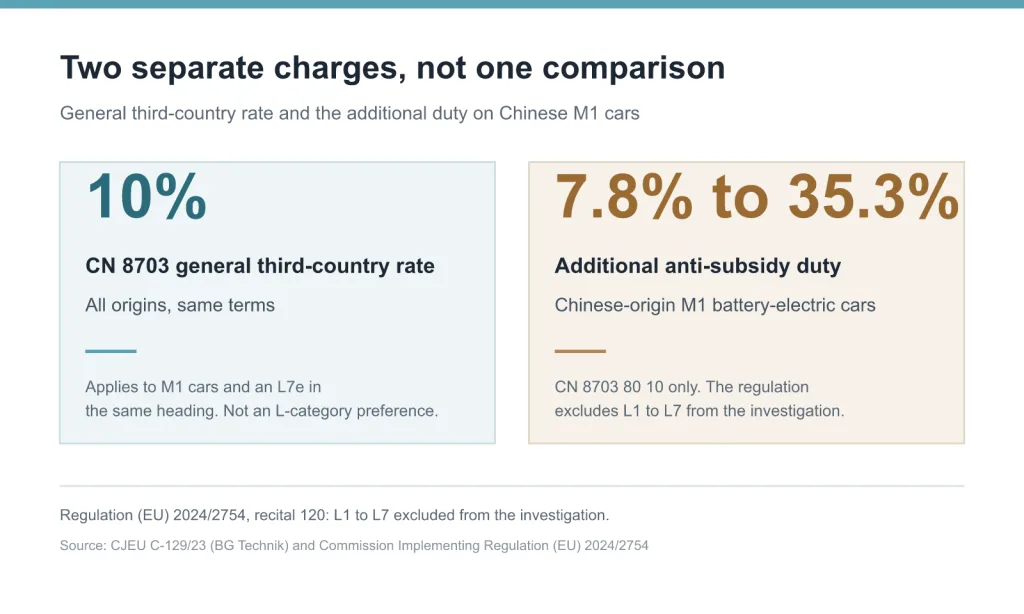
The 10 percent third-country rate is not a special advantage for the L categories. The cost variable that separates these tiers is whether a model falls inside the scope of the additional anti-subsidy duty on Chinese battery-electric cars.
The short version
- Treat the 45 km/h L6e class, the 80 km/h L7e class, and the 100 km/h city car tier as three distinct roles.
- The 10 percent CN 8703 rate is the general third-country rate for all origins. It applies to Chinese M1 cars and an L7e in the same heading, not as an L-category preference.
- The additional duty of 7.8% to 35.3% applies to Chinese M1 battery-electric cars in CN 8703 80 10. Its regulation excludes L1 to L7 vehicles from the investigation. That scope boundary, not the 10 percent rate, is the cost distinction.
- L-category vehicles have no separate whole-vehicle heading. Assessment under CN 8711 or CN 8703 follows construction and needs model-level BTI confirmation.
- Split budget and booth space from written inputs. NEDC is laboratory, real-world intervals move with conditions, and “up to” is a manufacturer ceiling.
1. Give each tier a role before comparing numbers
Assign each tier a job.
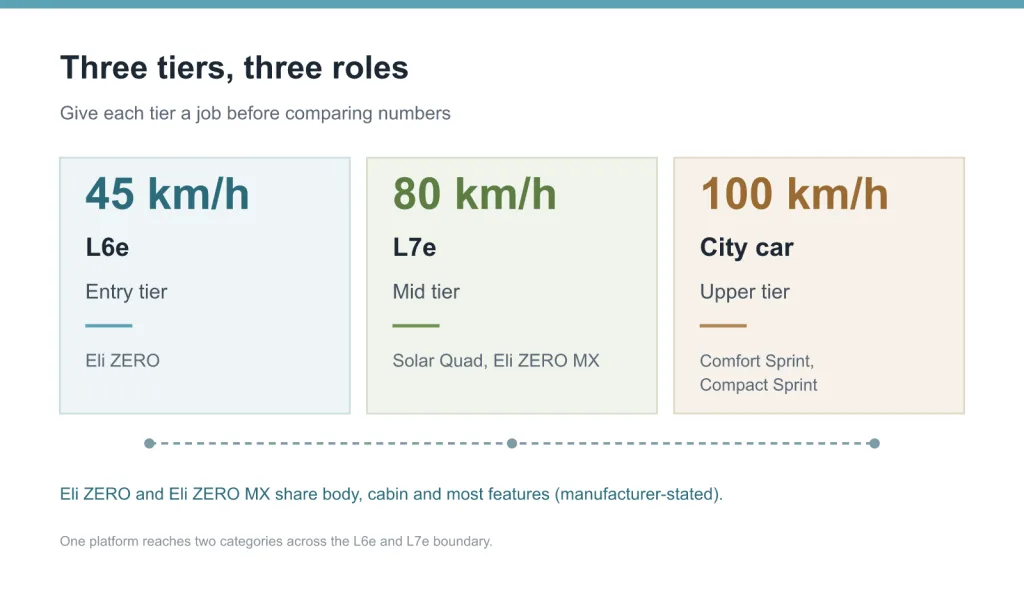
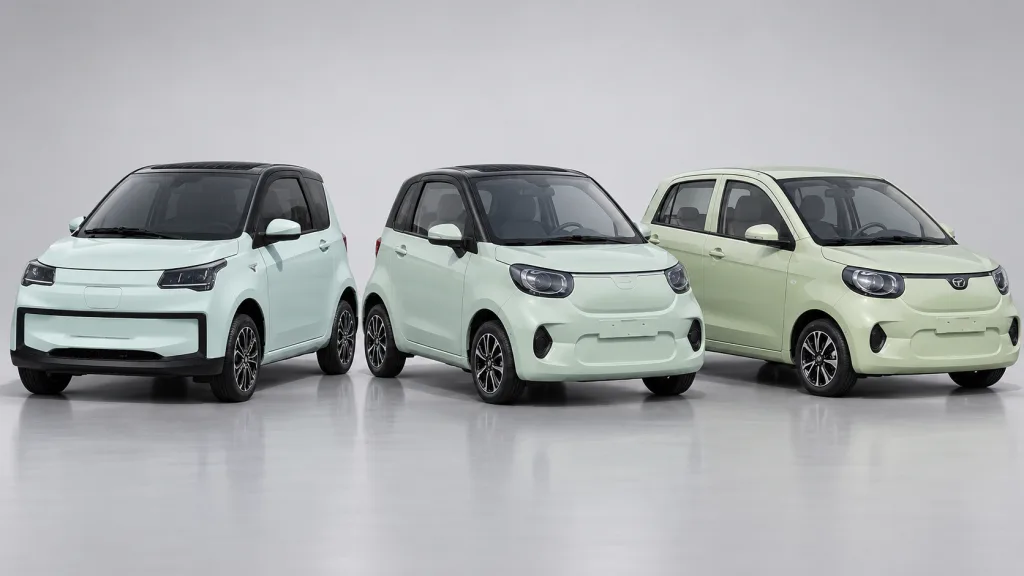
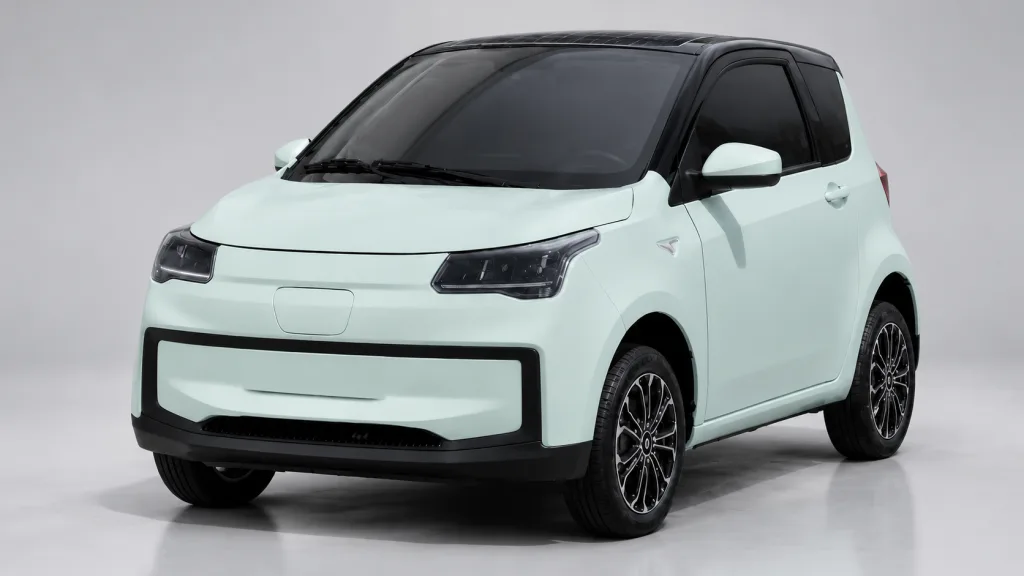
The 45 km/h L6e class sits at the low-speed end. The Eli ZERO is cited on its maker’s page as an L6e at 45 km/h, and that page says it shares its body, cabin and most features with the Eli ZERO MX, the L7e at 80 km/h. One body can therefore be offered on both sides of a category boundary. A choosing between L6e and L7e exercise is the place to work through that decision.
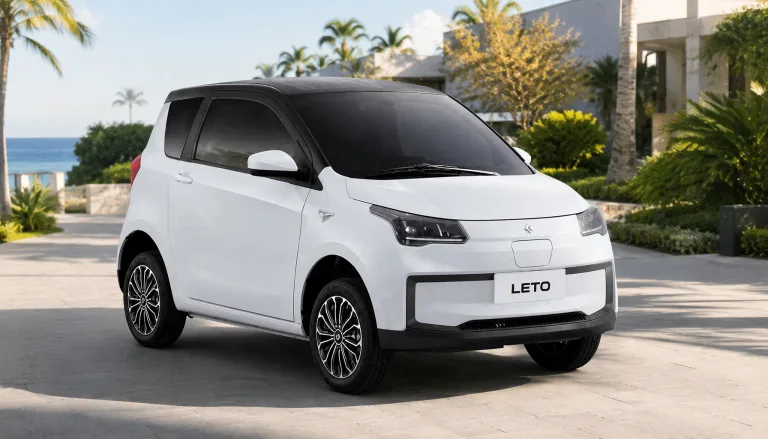
The 80 km/h L7e class is represented by the Solar Quad. Its page carries the title “Solar Quad L7e Electric Vehicle 3 Door 2 Seat” and describes an L7e-CU under certificate e13168/201302250*00. It lists a 23.66 kWh NCM622 battery with a 96 V system, 300 km NEDC, an E-LOOP configuration rated at over 400 km, and a two-seat, three-door body. No top speed is stated for this model, so the 80 km/h figure belongs to the class, not to a stated Solar Quad specification.
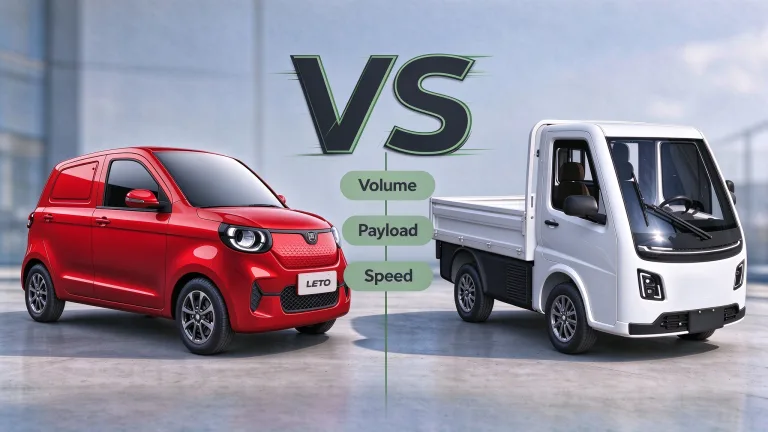
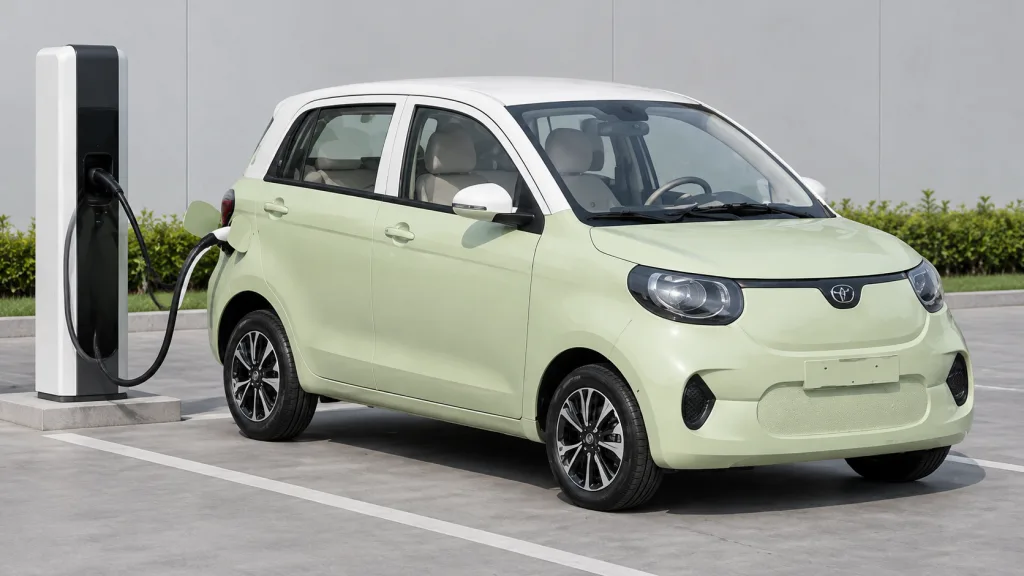
The 100 km/h city car tier holds the Comfort Sprint and Compact Sprint. The Comfort Sprint states 100 km/h, a 25 kW.h battery at 350 V, charging from empty to 80% in about 36 minutes, and 285 km NEDC. The Compact Sprint states 100 km/h, a 30 kW motor, an 18 kW.h LFP battery at 115 V, 230 km NEDC, and no fast-charge version. Each figure is manufacturer-stated.
2. Separate the general tariff from the additional duty
Keep the two charges apart.
The 10 percent attached to CN 8703 is the general third-country rate. It is the rate cited for that heading in the CJEU judgment in C-129/23 (BG Technik) and applies to all origins on the same terms. A Chinese M1 battery-electric car in CN 8703 and an L7e in the same heading face the same rate. It is not a lower rate for L-category vehicles and cannot show that an L7e is cheaper than an M1. A import duty and HS codes reference can frame how headings are read, but it does not turn a general rate into a preference.
The difference comes from a separate charge. Commission Implementing Regulation (EU) 2024/2754 imposes an additional anti-subsidy duty of 7.8% to 35.3% on Chinese-origin M1 battery-electric cars in CN 8703 80 10. Its recital 120 states that “all L1 to L7 categories of vehicles according to Regulation (EU) No 168/2013 were excluded from the scope of the investigation.” On that official basis, a Chinese-origin L6e or L7e does not stack the additional anti-subsidy duty merely because it is Chinese-origin. The scope of that exclusion is set out in the Notes.
The practical question is which charge applies to each model. A 10 percent line on every quote says nothing about tier economics. The answer follows the classification and origin of the specific model, not the label on the body style.
3. Do not let the L6e or L7e label decide the tariff heading
A common shortcut assumes an L-category vehicle has its own tariff line. It does not.
L-category vehicles have no independent whole-vehicle heading. The rate depends on construction and the heading under which the model is declared. Motorcycle-style steering points toward CN 8711, while car-style steering and a design principally for carrying passengers points toward CN 8703. Two vehicles with an L7e label can in principle be declared under different headings, so the answer is reached model by model. Where a rate is needed, it must be confirmed through Binding Tariff Information for that model. No rate is assigned to a named vehicle here.
Why an L7e is not an M1 also sits in the approval framework. Regulation (EU) 168/2013 and the M1 framework under Regulation (EU) 2018/858 are parallel systems. Article 2(2)(f) of Regulation (EU) 168/2013 places M1 vehicles outside that scope, and the Solar Quad’s L7e-CU certification is issued under the 168/2013 system, as stated on its page. This article draws no registration, road-use, or type-approval conclusion from that fact. A EU small electric vehicle category reference can carry the policy context.
4. Read EICMA 2026 as a post-show signal, not a launch
The 83rd International Motorcycle Exhibition was hosted at Fiera Milano Rho from November 3 to 8, 2026. The first two days were for media and professionals, with the show open to the public from November 5 to 8. That schedule follows EICMA’s own announcement, not a press release dateline. The show is over, so this is a recap of what the exhibits imply for sourcing.
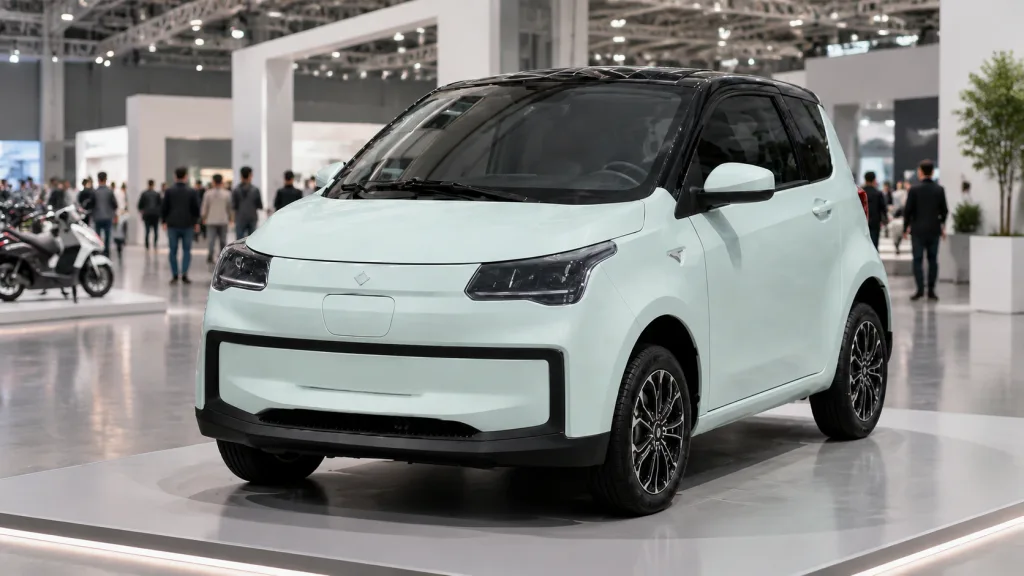
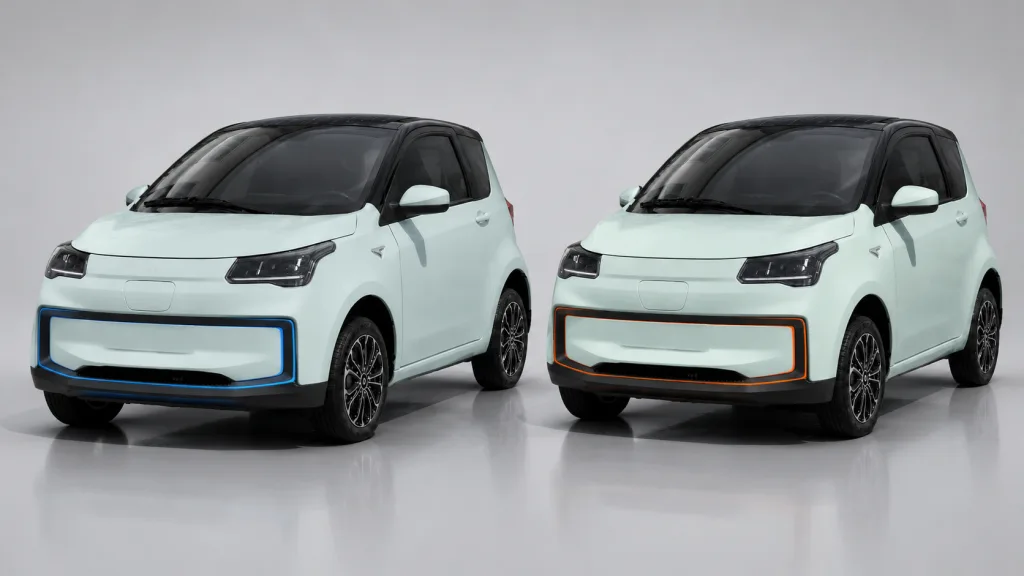
The relevant signal is the Eli display logic. Its maker states that the Eli ZERO is an L6e at 45 km/h and the Eli ZERO MX is an L7e at 80 km/h, and that the two share a body, cabin and most features. It states a 14.4 kWh LFP battery for the MX, a range phrased as “Up to 200 km” on the WMTC basis, and a 3.3 kW on-board charger, not the motor; the page states a 9 kW rated and 20 kW peak motor. It states standard ABS, EPS and air conditioning, and notes that real-world range varies with load, temperature, terrain and driving style, with homologated CoC figures prevailing.
One platform reaching two categories is what makes a three-tier budget worth planning. If a body can sit on either side of the L6e and L7e boundary, the choice of where to spend development and booth money is a commercial decision about duty scope, not a forced engineering split.
5. Build the input list and the question list before allocating
Allocation should follow written answers.
Inputs to record for each model:
- The intended tier, stated top speed, and the marketing name the supplier uses.
- The origin of the vehicle and battery, and the supplier’s written statement on whether the additional duty applies.
- The tariff heading the supplier expects to declare, and any Binding Tariff Information obtained.
- Battery capacity and chemistry, charging arrangement, and the conditions behind the quoted range.
- Booth footprint and equipment, and whether one body can serve more than one tier.
Questions to put to each supplier in writing:
- Under which heading will this model be declared, and is there a BTI decision to support it?
- Is the model inside or outside the additional duty scope, and on what basis is that stated?
- Which quoted figures are laboratory results and which are real-world intervals, and under what conditions?
- Does the configuration include fast charging, ABS, EPS and air conditioning, and how does that change between tiers?
- What warranty and certification language accompanies the figures?
A LSV registration in Europe reference can frame what happens after import, but this article reaches no registration or road-use conclusion. Weigh the answers against the importer’s own cost structure before assigning floor space.
6. Read the range figures with their conditions attached
Keep each figure with its label and conditions.
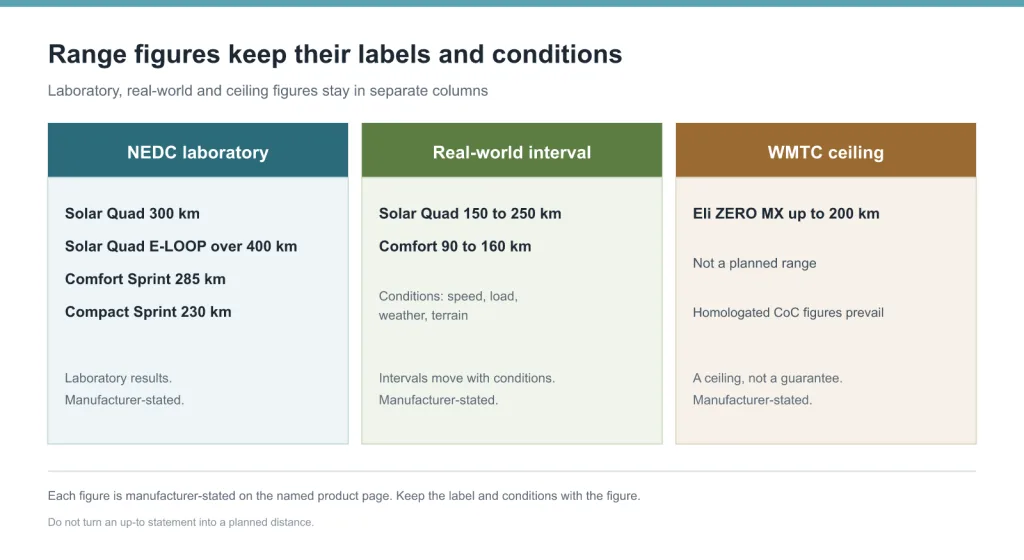
NEDC figures are laboratory results. The Solar Quad page states 300 km NEDC and an E-LOOP configuration rated at over 400 km, while its FAQ states that “Real-world driving typically lands between 150 and 250 km depending on speed, load and weather, with about 30 km added on a day of good sunlight.” The Comfort FAQ gives 90 to 160 km in mixed city and rural driving. These intervals are manufacturer-stated, depend on the named conditions, and are not merged here.
The Eli wording is different again. “Up to 200 km” is a WMTC ceiling, and its maker states that real-world range varies with load, temperature, terrain and driving style, with homologated CoC figures prevailing. A ceiling is not a planned range. The Leto pages note that “Figures are verified values and remain subject to regional certification,” a source statement, not a promise about any vehicle.
Keep laboratory and real-world figures in separate columns. Do not turn an “up to” statement into a planned distance, and do not use laboratory figures from the wider Leto range to promise range or a payback period.
Frequently asked questions
Is the 10 percent duty a special rate for L7e vehicles?
No. The 10 percent figure attached to CN 8703 is the general third-country rate for that heading and applies to all origins on the same terms. A Chinese M1 car classified in CN 8703 and an L7e classified in the same heading face the same rate. It is not an L-category preference and should not be presented as a saving of one tier over another. Ask the supplier which heading and rate apply to the specific model.
Do Chinese L6e and L7e vehicles carry the additional anti-subsidy duty on Chinese electric cars?
The implementing regulation that sets the additional duty of 7.8% to 35.3% for Chinese M1 battery-electric cars states in recital 120 that all L1 to L7 categories were excluded from the investigation. A Chinese-origin L6e or L7e therefore does not attract that duty merely because of its origin. The applicable charge for a given model still depends on how it is classified, so ask the supplier for a written scope statement and the tariff heading.
What decides the tariff heading if not the L6e or L7e label?
Construction and use decide it, not the category label. L-category vehicles have no separate whole-vehicle heading. A motorcycle-style steering arrangement points toward CN 8711, while a car-style arrangement and a design principally for carrying passengers points toward CN 8703. Because this is determined model by model, any specific rate should be confirmed through Binding Tariff Information before it is used in a budget.
Why is an L7e not treated as an M1 vehicle?
Regulation (EU) 168/2013 and the M1 framework under Regulation (EU) 2018/858 are parallel systems. Article 2(2)(f) of Regulation (EU) 168/2013 places M1 vehicles outside the scope of that regulation, and the Solar Quad states an L7e-CU certification under the 168/2013 system. This explains the classification boundary only. This article draws no registration, road-use, or type-approval conclusion from it.
How should an importer read figures such as NEDC and “up to 200 km”?
NEDC figures are laboratory results, while real-world intervals depend on speed, load, weather and terrain. The Solar Quad FAQ states 150 to 250 km in real driving, and the Comfort FAQ states 90 to 160 km in mixed city and rural use. The Eli phrase “Up to 200 km” is a WMTC ceiling, with the manufacturer noting that real-world range varies and homologated CoC figures prevail. Keep each figure with its conditions and treat none of them as a range guarantee or a savings claim.
Notes
All vehicle figures here are manufacturer-stated from the Leto and Eli product pages named above. They are not third-party measurements or industry-wide values, and no registration, road-use, or type-approval conclusion follows.
NEDC figures are laboratory results. The real-world intervals, 150 to 250 km from the Solar Quad FAQ and 90 to 160 km from the Comfort FAQ, are manufacturer-stated and depend on speed, load, weather, and use. The Eli “Up to 200 km” is a manufacturer-stated WMTC ceiling, not a guarantee; real-world range varies with load, temperature, terrain, and driving style, and homologated CoC figures prevail. No range guarantee, service life, payback period, or savings amount is claimed.
On the general rate: the Court of Justice judgment in C-129/23 (BG Technik) cites the CN tariff entry “8703 10 18 Other 10 p/st”, the general third-country rate for that heading applying to all origins, not an L-category preference. Source: CJEU C-129/23, https://eur-lex.europa.eu/legal-content/EN/TXT/HTML/?uri=CELEX:62023CJ0129
On the additional duty: Commission Implementing Regulation (EU) 2024/2754 sets 7.8% to 35.3% on Chinese-origin M1 battery-electric cars in CN 8703 80 10, and recital 120 states that all L1 to L7 categories under Regulation (EU) No 168/2013 were excluded from the investigation. Source: https://eur-lex.europa.eu/eli/reg_impl/2024/2754/oj/eng ; rates: European Commission press release IP_24_5589, https://ec.europa.eu/commission/presscorner/detail/en/ip_24_5589
On L-category scope: Regulation (EU) 168/2013, Articles 3(70), 4(2)(g) and 2(2)(f), the last placing M1 outside that scope. Source: https://eur-lex.europa.eu/legal-content/EN/TXT/?uri=CELEX:32013R0168
On third-country duties: European Commission TARIC explanation, https://taxation-customs.ec.europa.eu/customs-4/calculation-customs-duties/customs-tariff/eu-customs-tariff-taric_en
L-category vehicles have no independent whole-vehicle tariff heading. Any rate depends on model-level classification under CN 8711 or CN 8703 and needs Binding Tariff Information. No rate is assigned to a named model here. EICMA dates come from the exhibition’s own announcement.